




Register Now
Fill out this form to get a quote within 24 hours.

Islam is a beautiful religion that teaches humans a complete way of life. A “Deen” that touches every corner of our existence. From how we conduct business to how we treat our neighbours, there is guidance for everything. But at the core of this religion lies a single, powerful physical act: the Sajdah.
If you have ever spent time reciting the Quran, you must have felt that quiet, rhythmic flow of the verses. Suddenly, you see a small symbol in the margin, a mosque dome or the word Sajdah in the Quran. This is a moment where the Creator of the universe asks you to stop whatever you are doing and put your forehead to the ground.
In this guide, we aren’t just looking at the rules. We are exploring the spiritual depth, the physical benefits, and the profound peace that comes from the most humble position a human being can take.
In short, this blog will let you know about the importance of Sajdah in Islam, types of Sajda, and the total Sajdah in the Quran, where Allah prostrates.
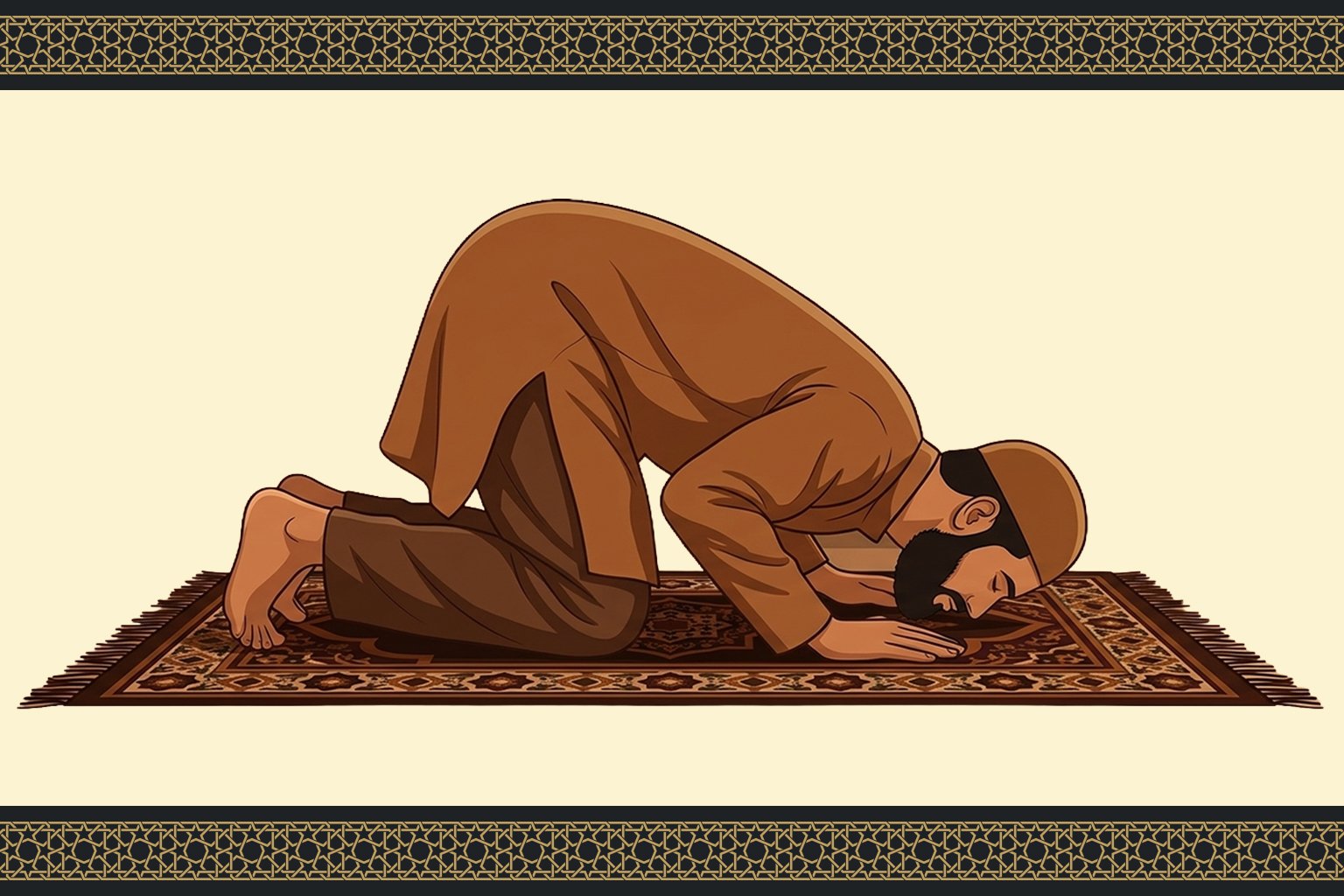
What does it mean to prostrate? Physically, it is a simple movement. But spiritually, it is an act of submission to Allah.
When a Muslim performs Sajdah, eight points of the body must touch the ground:
By placing your most noble part, “your face,” on the level of the dust, you are making a silent declaration: “I am not the master of my own fate; Allah is.”
Sajdah is the ultimate equalizer. Whether you are a king or a commoner, a billionaire or a student, everyone puts their head on the same ground before Allah. During Salah, all people stand equal regardless of their name, colour, status, or social class.
In the modern world, we are taught to be “self-made” and “proud.” Sajdah teaches us the opposite: that we are created by Allah and should be humble.
Many people think Sajdah only happens during our five daily prayers. In reality, the Islamic tradition offers us several reasons to bow. There are three types of Sajda in the Quran, and each has its own significance:
Sujood al-Tilawah in the Quran is a spontaneous act of worship triggered by the Word of Allah. When you read a verse that mentions how the stars prostrate, or how the arrogant refuse to bow, you respond by doing exactly what the verse describes. It is a way of saying, “I am listening, and I obey.”
Life is full of ups and downs. You are getting a job, a child is being born, or even surviving a close call on the road. The Prophet Muhammad (PBUH) taught us that when good news arrives, we shouldn’t just celebrate with words. We should remember Allah even in the bad days and perform Sajdah. This act keeps us grounded and reminds us that our success isn’t just because of our hard work, but because of Allah’s mercy.
We are human. Our minds wander. Sometimes in prayer, we forget whether we are on the third or fourth Rak’ah. Islam provides a solution for our prayers through Sujood al-Sahwi. Instead of having to restart the whole prayer, you have to do two extra bows at the end to complete your worship.
There are 15 specific places in the Quran where Sajdah is recommended. These 15 verses of the Quran call upon the believer to pause the Quran recitation and perform Sajdah as an act of obedience. To understand the “why,” we have to look at what these verses are saying.
Some of the Surahs that contain Sajdah Ayaat include:
| No. | Part No. | Surah | Verse No. | Verse | Translation |
| 1 | 9 | Al-A‘raf | 7:206 | إِنَّ ٱلَّذِينَ عِندَ رَبِّكَ لَا يَسْتَكْبِرُونَ عَنْ عِبَادَتِهِۦ وَيُسَبِّحُونَهُۥ وَلَهُۥ يَسْجُدُونَ | Surely those nearest to your Lord are not too proud to worship Him. They glorify Him, and to Him they prostrate. |
| 2 | 13 | Ar-Ra‘d | 13:15 | وَلِلَّهِ يَسْجُدُ مَن فِى ٱلسَّمَاوَاتِ وَٱلْأَرْضِ طَوْعًا وَكَرْهًا | To Allah prostrates whoever is in the heavens and the earth, willingly or unwillingly. |
| 3 | 14 | An-Nahl | 16:49–50 | وَلِلَّهِ يَسْجُدُ مَا فِى ٱلسَّمَاوَاتِ وَمَا فِى ٱلْأَرْضِ… يَخَافُونَ رَبَّهُم مِّن فَوْقِهِمْ | To Allah prostrates all that is in the heavens and the earth, and they fear their Lord above them and do what they are commanded. |
| 4 | 15 | Al-Isra | 17:109 | وَيَخِرُّونَ لِلْأَذْقَانِ يَبْكُونَ وَيَزِيدُهُمْ خُشُوعًا | They fall upon their faces weeping, and it increases them in humility. |
| 5 | 16 | Maryam | 19:58 | إِذَا تُتْلَىٰ عَلَيْهِمْ ءَايَاتُ ٱلرَّحْمَٰنِ خَرُّوا۟ سُجَّدًا وَبُكِيًّا | When the verses of the Most Merciful were recited to them, they fell down in prostration and weeping. |
| 6 | 17 | Al-Hajj | 22:18 | أَلَمْ تَرَ أَنَّ ٱللَّهَ يَسْجُدُ لَهُۥ مَن فِى ٱلسَّمَاوَاتِ وَمَن فِى ٱلْأَرْضِ | Do you not see that to Allah prostrates whoever is in the heavens and whoever is on the earth? |
| 7 | 17 | Al-Hajj | 22:77 | يَٰأَيُّهَا ٱلَّذِينَ ءَامَنُوا ٱرْكَعُوا وَٱسْجُدُوا وَٱعْبُدُوا رَبَّكُمْ | O believers, bow down, prostrate yourselves, and worship your Lord. |
| 8 | 19 | Al-Furqan | 25:60 | وَإِذَا قِيلَ لَهُمُ ٱسْجُدُوا لِلرَّحْمَٰنِ قَالُوا وَمَا ٱلرَّحْمَٰنُ | When it is said to them, “Prostrate to the Most Merciful,” they say, “What is the Most Merciful?” |
| 9 | 19 | An-Naml | 27:25–26 | أَلَّا يَسْجُدُوا لِلَّهِ ٱلَّذِى يُخْرِجُ ٱلْخَبْءَ فِى ٱلسَّمَاوَاتِ وَٱلْأَرْضِ | So that they do not prostrate to Allah, Who brings forth what is hidden in the heavens and the earth. |
| 10 | 21 | As-Sajdah | 32:15 | إِنَّمَا يُؤْمِنُ بِـَٔايَاتِنَا ٱلَّذِينَ إِذَا ذُكِّرُوا بِهَا خَرُّوا۟ سُجَّدًا | Only those truly believe in Our verses who, when reminded of them, fall down in prostration. |
| 11 | 23 | Sad | 38:24 | وَظَنَّ دَاوُۥدُ أَنَّمَا فَتَنَّٰهُ فَٱسْتَغْفَرَ رَبَّهُۥ وَخَرَّ رَاكِعًا وَأَنَابَ | Dawud realized that We had tested him, so he sought forgiveness of his Lord and fell down in prostration, turning in repentance. |
| 12 | 24 | Fussilat | 41:37–38 | لَا تَسْجُدُوا لِلشَّمْسِ وَلَا لِلْقَمَرِ وَٱسْجُدُوا لِلَّهِ ٱلَّذِى خَلَقَهُنَّ | Do not prostrate to the sun or the moon, but prostrate to Allah Who created them. |
| 13 | 27 | An-Najm | 53:62 | فَٱسْجُدُوا لِلَّهِ وَٱعْبُدُوا | So prostrate to Allah and worship Him. |
| 14 | 30 | Al-Inshiqaq | 84:21 | وَإِذَا قُرِئَ عَلَيْهِمُ ٱلْقُرْءَانُ لَا يَسْجُدُونَ | When the Quran is recited to them, they do not prostrate. |
| 15 | 30 | Al-‘Alaq | 96:19 | كَلَّا لَا تُطِعْهُ وَٱسْجُدْ وَٱقْتَرِب | No indeed, do not obey him; rather prostrate and draw near. |
Why do we feel so good after a Sajdah? Science is beginning to catch up with what believers have known for 1,400 years.
When you put your head lower than your heart, blood flow to the brain increases. This is associated with better mental clarity and a decrease in stress hormones like cortisol. But beyond the biology, there is a “spiritual release.” When you say “Subhana Rabbiyal A’la” (Glory is to my Lord, the Most High), you are essentially handing your problems over to the One who can actually solve them.
The Prophet (PBUH) said: “The nearest a servant comes to his Lord is when he is prostrating.” If you are feeling lonely, unheard, or overwhelmed, the Sajdah is your direct line. You don’t need a middleman. You just need a clean spot on the earth and a sincere heart where you can connect with your creator.
To make your Sajdah valid and respectful, there are a few practical steps to follow.
Some scholars say to perform Sajdah Tilawah without Wudu, while the majority of scholars recommend being in a state of Wudu as a sign of respect for the Quran.
You should face the Qibla (Makkah) just as you do in regular prayer. The ground should be clean. But, if you are in a public place and cannot find a prayer mat, any clean surface, such as grass or a clean floor, is perfectly fine for prostration.
There is a beautiful Sunnah Dua specifically for the Quranic Sajdah:
سَجَدَ وَجْهِيَ لِلَّذِي خَلَقَهُ، وَشَقَّ سَمْعَهُ وَبَصَرَهُ، بِحَوْلِهِ وَقُوَّتِهِ، فَتَبَارَكَ اللَّهُ أَحْسَنُ الْخَالِقِينَ“
Meaning:
“My face has prostrated to the One who created it and brought forth its hearing and sight by His power and strength. So blessed is Allah, the Best of creators.”
Reciting this helps you reflect on the miracle of your own existence while you are in that humble state.
One of the most chilling parts of the Quranic narrative is the story of Iblis (Shaytan). His downfall wasn’t that he didn’t believe in God; he did. His downfall was his refusal to perform a single Sajdah.
When we perform Sajdah, we are winning a battle against that same arrogance. Every time you go down, you are annoying the Shaytan and proving that you are a humble servant of the Most High. This is why, in many Hadiths, it is mentioned that Shaytan weeps when he sees a believer prostrating.
Abu Huraira reported that the Prophet Muhammad SAW said:
When a person while reciting the Quran reaches the point of Sajdah in the surah and he does a sajdah then the Shaitaan cries and separates himself from that person and wails” O Disaster! When he was commanded to do Sajdah, he performed sajdah, thus for him, there are the gardens of Jannah. When I was commanded to do sajdah I did not do sajdah, and for me, there is the Fire.” [Sahih Muslim]
We spend our lives trying to “climb the ladder” and get to the top. But in Islam, the way to the top is actually found at the bottom.
The Sajdah is more than just a physical gesture; it is a spiritual experience. It is a place where you can cry without shame, speak without being judged, and listen to the silence of your own soul. The next time you see that symbol in your Mushaf, see it as a gift. A way to get close to Allah, let go of your burdens, and find the peace that only a prostration can provide.
You are not expected to pull over and put your head on the steering wheel. You can make a mental intention or nod your head, then perform the Sajdah when you reach your destination.
Yes, you say it as you go down and as you come up.
Since it is an act of worship similar to prayer, most scholars advise following the same dress code as Salah.
According to most of the scholars, there are 15 verses of the Sajdaa Ayaat.
Sajdah means performing a prostration. When you are reciting the Quran and read a specific verse that calls for submission to Allah, you obey.
No, it is not necessary to do Sujood immediately. But still, it is الأفضل to perform Sajdah as soon as possible.
As we discussed earlier, this is an act of worship similar to prayer. So, it is better to do wudu before prostration.
Muslims can say Subhana Rabbiyal A’la or can recite a Sunnah dua.
