You want to learn the Quran properly. But the local masjid classes are mixed-gender or taught by a male teacher. The timings don’t work around your kids’ schedule. Or there’s simply no female Quran teacher available in your area.
This is the reality for most Muslim women living in the West — and it’s the reason so many sisters delay their Quran education for years, sometimes decades.
Online Quran classes solve every one of these barriers. You learn from a qualified female teacher, from your home, at times that fit around your life — whether that’s during school hours, after the kids are in bed, or early morning before the house wakes up.
Why Women Delay Learning the Quran (and Why They Shouldn’t)
The reasons are almost always practical, not spiritual. Most women want to learn — they just haven’t found an option that works for their life.
“I can’t find a female teacher nearby.” In many Western cities, qualified female Quran teachers are rare. The few who are available often have full schedules or teach group classes at fixed times. Online academies employ female teachers from Egypt, Jordan, and Pakistan — the pool is global, so availability is never an issue.
“I don’t have time with kids and work.” This is the most common barrier. Between school runs, meals, homework, and household responsibilities, there’s no 90-minute block for a masjid class. But there is a 30-minute window — after Fajr, during nap time, after Isha. Online classes need only 30 minutes and you don’t lose another 30 minutes driving each way.
“I feel embarrassed starting from the basics at my age.” In a 1-on-1 online class, there’s no audience. No group of women watching you struggle with letters. No children in the same class who read faster than you. It’s just you and your teacher — a woman who has taught hundreds of adult beginners and knows exactly how to build your confidence without judgment.
“My family responsibilities come first.” Islam doesn’t ask you to choose between family and faith. The Prophet ﷺ said: “Seeking knowledge is an obligation upon every Muslim” — he didn’t add “except mothers” or “except wives.” Your spiritual growth isn’t a luxury that comes after everything else is done. It’s a right and a responsibility.
Aisha bint Abu Bakr (RA) was one of the greatest scholars in Islamic history. She narrated over 2,000 Hadith and was consulted by senior companions on matters of Fiqh. Fatimah al-Fihri founded the world’s first university. Women’s scholarship isn’t a modern innovation — it’s a tradition as old as Islam itself.
What Makes Online Classes Work for Women
Female Teachers Who Understand Your Reality
Your teacher isn’t just female — she’s a qualified Quran instructor who understands the practical challenges you face as a woman balancing faith with family, work, and daily life.
Our female teachers hold certifications in Tajweed, Quran Reading, and Islamic Studies. Many are Hafizat (have memorized the entire Quran). They teach in English, Urdu, and Arabic — so language is never a barrier.
They’re also patient with adult beginners in a way that goes beyond professional training. They’ve seen the nervousness that comes with reading aloud for the first time in years. They know how to encourage without patronizing. And they understand when you need to pause a session because your toddler just woke up — because many of them are mothers too.
Complete Privacy
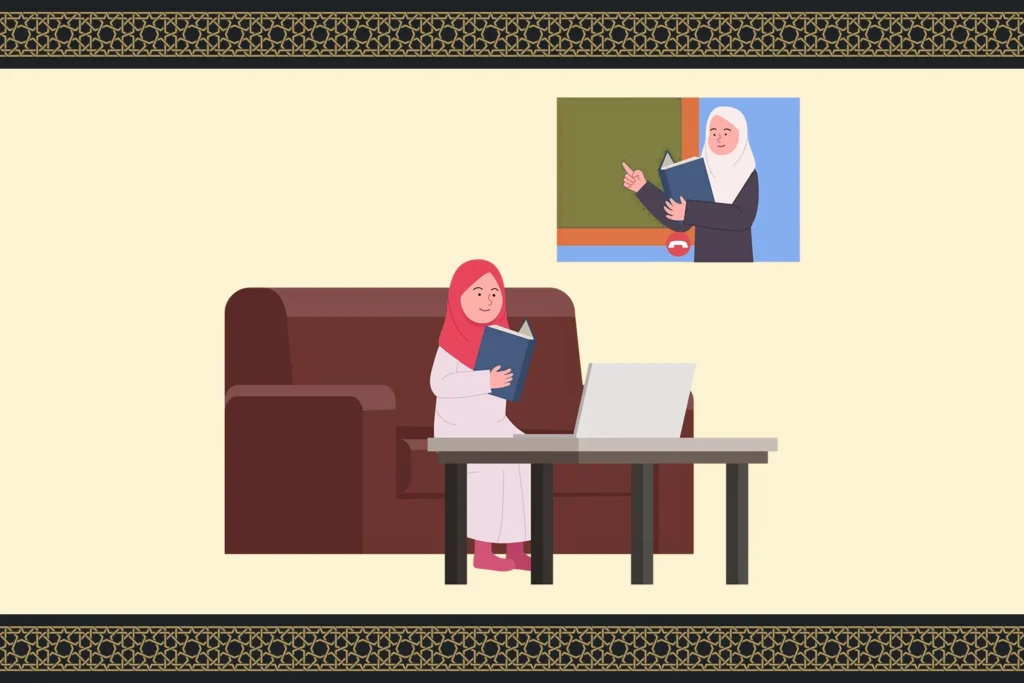
Your class is a 1-on-1 video call from wherever you’re comfortable — your bedroom, your living room, your office. Nobody else is in the session. Nobody hears your mistakes. You can wear what you’re comfortable in at home.
For sisters who observe strict hijab or niqab practices, this removes a layer of complexity that masjid classes sometimes create. Your learning environment is entirely within your control.
Scheduling That Fits a Woman’s Day
Your day doesn’t follow a 9-to-5 pattern — and your Quran class shouldn’t either.
Morning sessions (after kids leave for school) work for stay-at-home mothers. Lunch-break sessions work for working professionals. Evening sessions (after Isha) work for women whose days are fully committed until bedtime. Weekend sessions work for students or women with unpredictable weekday schedules.
If your schedule changes week to week — and most women’s do — you can adjust your class times accordingly. Miss a session with advance notice and it’s rescheduled, not lost.
What You Can Learn
Every course available to any student is available to you with a female teacher:
Learn to read Arabic from scratch → Noorani Qaida — 3–6 months
Read the Quran fluently → Quran Reading — 6–12 months
Perfect your recitation with Tajweed → Tajweed ul Quran — 6–12 months
Memorize the Quran (Hifz) → Hifz Quran — 2–4 years
Understand what you recite → Quran Tafseer — 12+ months
Learn Salah, Duas, and Islamic basics → Islamic Course for Beginners — 3–6 months
Many women start with Noorani Qaida and progress through the learning path naturally. Others come with existing reading ability and want to focus specifically on Tajweed or Tafseer. Your teacher assesses your level in the trial classes and recommends where to start.
Learning Alongside Your Children
Many mothers enroll themselves alongside their children — separate classes, same academy. This creates something powerful: your kids see you learning the Quran too. Not just telling them it’s important, but showing them by doing it yourself.
Mothers who learn alongside their children report that Quran practice at home becomes natural. You can listen to your child’s recitation between their sessions and catch mistakes. You understand what they’re being taught because you’re studying the same material at a different level. And your child takes Quran learning more seriously when they see it’s not just “for kids.”
Some families schedule back-to-back sessions — the child’s class first, then the mother’s immediately after — so the learning habit is shared.
What to Expect in Your First Class
Your first session isn’t a test — it’s a conversation.
Your female teacher introduces herself and asks about your background: did you learn Quran as a child? Can you read Arabic letters? Have you studied Tajweed before? Is there a specific goal you’re working toward (memorizing certain Surahs, understanding what you read, improving your recitation for Salah)?
Based on your answers, she assesses your current level and shows you where you’d start in the curriculum. If you’re a complete beginner, that’s Noorani Qaida page one. If you can already read but your Tajweed needs work, she might start you directly in the Tajweed course.
There’s no pressure to enroll during the trial. You get 3 full sessions to experience the teaching style, build comfort with your teacher, and decide if it’s right for you.
Start With 3 Free Trial Classes
3 sessions with a qualified female teacher. From your home. At times that work for you. No credit card. No obligation.
Recommended plan: Standard — 3 classes/week ($40/month) or Starter — 2 classes/week ($30/month) if you’re working around a tight schedule.
→ Female Quran Teacher Online — more about our female teaching team
→ Pricing
FAQs
Do you have female Quran teachers? Yes. We have qualified female teachers (Qariah, Hafizat, and Alimat) who teach all courses — Noorani Qaida, Quran Reading, Tajweed, Hifz, Tafseer, and Islamic Studies. They teach in English, Urdu, and Arabic.
Can I request a female teacher specifically? Yes. When you book your trial classes, simply mention that you’d like a female teacher. We’ll match you with a qualified Qariah or Hafiza based on your course and schedule preferences.
What if I’m a complete beginner and I’ve never read Arabic? That’s exactly where most of our adult female students start. You’ll begin with Noorani Qaida — Arabic letters and sounds from scratch. No prior knowledge is needed. Your teacher will guide you step by step with patience and zero judgment.
Can I take classes while my kids are at school? Yes. Many mothers schedule their sessions during school hours (9 AM – 2 PM) when the house is quiet. Evening sessions after Isha and weekend sessions are also available.
What do I need for an online class? A smartphone, tablet, or laptop with a camera and microphone, plus a stable internet connection. No special software — classes run on Zoom or Skype.
Can I learn Hifz (memorization) with a female teacher? Yes. Our female Hifz teachers are Hafizat who have memorized the entire Quran themselves. They follow the same Sabaq-Sabqi-Manzil revision system used in traditional Hifz programs.
How much do classes cost? $30/month for 2 classes per week, $40/month for 3, $45/month for 4, or $55/month for 5. All plans include 1-on-1 sessions with your chosen female teacher. Families enrolling multiple members receive a 20% discount. See pricing →
Is there a family discount if my children and I both enroll? Yes — families enrolling multiple members receive a 20% discount on all plans. Contact us to set up your family package.