Ten years ago, suggesting someone learn the Quran through a screen would have raised eyebrows. Today, online Quran classes are how hundreds of thousands of Muslims — in the US, UK, Canada, Australia, and across Europe — are learning to read, recite, and memorize the Quran.
But does it actually work? Is a video call really as effective as sitting in front of a teacher at a masjid?
For most students, online Quran learning is not just “as good” as in-person classes — it’s better. Here’s why.
1. One-on-One Attention That Physical Classes Rarely Offer
This is the single biggest advantage, and most people overlook it.
In a typical masjid or Islamic center class, one teacher sits with 10–20 students. Each student gets a few minutes of individual attention per session. The rest of the time, they’re waiting, listening to others recite, or practicing alone without correction.
In an online Quran class, it’s just you and your teacher for the entire session. Every minute of a 30-minute class is spent on your recitation, your mistakes, your Tajweed. Your teacher hears every letter you pronounce and corrects it immediately.
For beginners especially, this changes everything. Bad pronunciation habits form in the first few weeks of learning. A 1-on-1 teacher catches them before they solidify. A group class lets them pass unnoticed.
2. Access to Qualified Teachers You’d Never Find Locally
If you live in Houston, Chicago, or London, finding a Quran teacher nearby who is qualified in Tajweed, available at your preferred time, speaks your language, and matches your gender preference is difficult. Finding all four in one person is rare.
Online classes remove geography from the equation entirely. Your teacher could be an Ijazah-certified Qari from Egypt, a Hafiza with a degree in Quranic Sciences from Jordan, or an experienced tutor from Pakistan who specializes in teaching non-Arabic speakers.
You choose based on qualifications and fit, not proximity.
For women specifically: Many sisters are uncomfortable learning from a male teacher, and female Quran teachers are hard to find in most Western cities. Online academies employ qualified female teachers — so sisters learn in a comfortable, private environment with an instructor who understands their needs.
3. Flexible Scheduling That Fits Real Life
Physical Quran classes run at fixed times — usually after Maghrib or on weekends. If you work late, travel frequently, or have children with packed school schedules, those fixed slots rarely work.
Online classes adapt to you:
Working adults can schedule sessions early morning before work, during a lunch break, or late evening. Children can learn after school without a parent driving them anywhere. Families in different time zones can find teachers available at any hour — many academies operate around the clock. Missed a session? Most online programs let you reschedule instead of losing the class.
This flexibility is why adults — who make up a growing share of online Quran students — consistently stick with online classes longer than they ever lasted with in-person ones. When learning fits into your life instead of competing with it, you don’t quit.
4. Your Home Becomes a Safe, Comfortable Classroom
Learning the Quran requires vulnerability. You’re going to mispronounce letters. You’re going to stumble over words. You’re going to feel slow.
Doing that in a room full of other students — especially as an adult beginner — feels exposing. Many adults delay learning the Quran for years specifically because of this embarrassment.
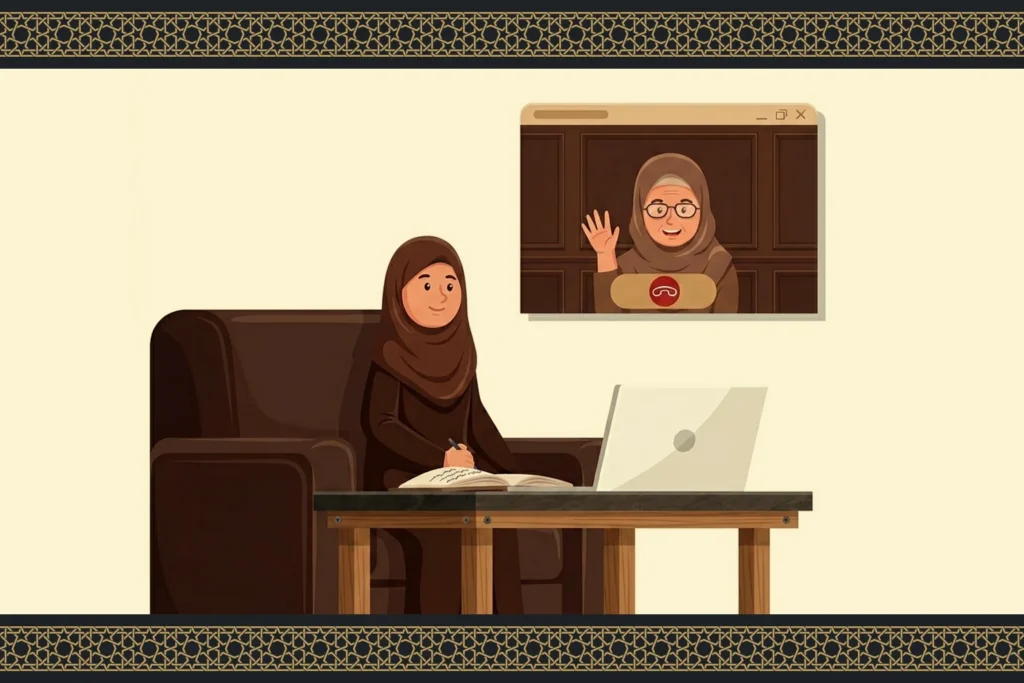
At home, that barrier disappears. You’re in your own space. It’s just you and your teacher on screen. There’s no one else listening to your mistakes. No commute. No sitting on a hard floor for an hour.
For parents: You can sit nearby during your child’s class and hear exactly what’s being taught. You know who the teacher is, how they interact with your child, and what progress is being made — without dropping them off somewhere and hoping for the best.
5. It Costs Less Than In-Person Classes
Online Quran academies don’t pay rent for a physical classroom, don’t maintain a building, and employ teachers in countries with lower costs of living. Those savings pass directly to you.
A typical online Quran class costs between $35–80/month for 2–3 sessions per week. Comparable in-person instruction at a private Islamic center or with a local tutor often costs $150–300/month.
You’re paying less and getting more individual attention. That math rarely works out this well.
6. Structured Progression Instead of Random Lessons
A common problem with informal Quran learning — whether at a local masjid or with a family friend who teaches on the side — is the lack of structure. Students read the Quran from wherever they left off last time, with no curriculum, no milestones, and no clear sense of progress.
Good online Quran academies follow a structured learning path:
Noorani Qaida → master Arabic letters and basic reading
Quran Reading → read through the Quran with fluency
Tajweed → learn the rules of proper recitation in depth
Hifz → memorize portions or the entire Quran
Tafseer → understand the meaning of what you recite
Each stage has clear completion criteria. You know where you are, what’s next, and how far you’ve come. That structure keeps students motivated in a way that “just keep reading” never does.
7. Technology That Makes Learning Stick
Modern online Quran platforms use tools that a physical classroom simply doesn’t have:
Screen sharing so teacher and student look at the same Quran page simultaneously. Digital whiteboards for writing out Tajweed rules and letter formations. Session recordings so students can replay their teacher’s pronunciation and compare it to their own. Progress dashboards that track lessons completed, Surahs covered, and Tajweed rules learned. Monthly evaluation reports that show parents (or adult students) exactly where improvement is happening.
These aren’t gimmicks — they’re tools that reinforce learning between sessions. A student who can replay their teacher saying a difficult word 10 times at home will master it faster than one who heard it once in a classroom and forgot it by the next day.
Who Benefits Most From Online Quran Classes?
Beginners and adult learners — The privacy of 1-on-1 online classes removes the embarrassment barrier that stops many adults from starting. The Prophet ﷺ said: “The one who recites the Quran while struggling receives two rewards” (Sahih al-Bukhari & Muslim). Your struggle is rewarded, and online classes let you struggle without an audience.
Children ages 5–15 — Kids learn best with short, focused sessions and individual attention. A 30-minute 1-on-1 online class is more productive than a 90-minute group class where your child gets 10 minutes of actual teacher interaction.
Women and girls — Access to qualified female teachers, learning from the privacy of home, and no mixed-gender classroom concerns.
Muslims in non-Muslim countries — If the nearest masjid with Quran classes is 45 minutes away, online eliminates a 90-minute round trip for every session.
Busy professionals — You don’t have to choose between your career and your Quran education. Early morning, lunch hour, or late night — your teacher is available.
The One Thing Online Classes Can’t Replace
Honesty matters: online Quran learning has one limitation worth naming.
It doesn’t replicate the social and communal experience of learning at a masjid — the sense of belonging to a local Muslim community, praying together after class, the organic mentorship that happens in person.
If you have access to a good local teacher with small class sizes and a time that works for you, that’s valuable. Don’t leave it for online.
But for most Muslims in the West, that ideal scenario doesn’t exist. The local options are limited, inconvenient, or non-existent. Online Quran classes aren’t a compromise — they’re the solution that makes consistent Quran education actually possible.
Try a Free Class Before You Decide
The best way to know if online Quran learning works for you is to experience it.
In a free trial class, you’ll:
Join a live 1-on-1 video call with a qualified teacher. Get assessed on your current level — whether you’re a complete beginner or returning after years. See exactly how the technology, teaching style, and lesson flow work. Receive a recommendation for which course fits your goals.
No payment. No commitment. Just one session to see for yourself.
FAQs
Is online Quran learning really effective? Yes. Students in 1-on-1 online classes typically progress faster than those in group settings because every minute of the session is spent on their recitation with immediate correction.
Is it safe for my child to learn Quran online? Yes. Sessions happen in your home where you can supervise. Reputable academies also vet teachers thoroughly and provide session recordings and progress reports.
What if I’ve never read Arabic before? That’s exactly where most online students start. The course begins with Noorani Qaida — Arabic letters and sounds from scratch. No prior knowledge is needed.
Can I choose a female teacher? Yes. Qualified female Quran teachers are available for women, girls, and young children who prefer a female instructor.
How much do online Quran classes cost? Plans typically start around $39/month for two 30-minute sessions per week. See full pricing →
What equipment do I need? A smartphone, tablet, or laptop with a camera, microphone, and stable internet. No special software — most classes run on Zoom or Skype.
What’s the difference between online Quran classes and YouTube/apps? YouTube and apps are passive — no one corrects your pronunciation. Online classes are live with a real teacher who listens to you recite and fixes mistakes in real time. That feedback loop is what makes the difference between learning and just practicing errors.