Umrah is a pilgrimage to Makkah that a Muslim can perform at any time of the year — unlike Hajj, which has fixed dates. It is not obligatory (Fard) like Hajj, but it is a highly recommended Sunnah with immense spiritual reward.
The Prophet ﷺ said: “The performance of Umrah is an expiation for the sins committed between it and the previous one.” (Sahih al-Bukhari)
Whether this is your first Umrah or you want to review the steps before going again, this guide walks you through every stage — from entering Ihram to the final hair cutting — with the Duas, rules, and common mistakes you need to know.
Before You Begin: What Umrah Requires
Niyyah (Intention): Your intention must be sincere and purely for the sake of Allah. Umrah performed for showing off or social status carries no reward.
Physical ability: You should be healthy enough to complete the rituals, which involve significant walking (Tawaf and Sa’i together cover roughly 5+ kilometers).
Knowledge of the rituals: Knowing the steps, their order, and the key Duas before you arrive in Makkah makes the experience calmer and more meaningful. Many pilgrims arrive without proper preparation and feel overwhelmed by the crowds and the pace.
Quranic preparation: The more Quran you’ve memorized, the richer your Tawaf and Sa’i become — because you have verses and Surahs to recite throughout. Pilgrims who can recite only Al-Fatiha and a few short Surahs often wish they’d memorized more before arriving.
The 4 Steps of Umrah
Umrah consists of four rituals performed in order:
- Ihram — entering the sacred state
- Tawaf — circling the Kaaba seven times
- Sa’i — walking between Safa and Marwah seven times
- Halq or Taqsir — shaving or trimming the hair
Each step has specific rules, Duas, and spiritual meaning.
Step 1: Ihram — Entering the Sacred State
Ihram is not just clothing — it’s a state of spiritual purity and intention. You enter Ihram before crossing the Miqat (the boundary points designated by the Prophet ﷺ for pilgrims approaching Makkah).
How to enter Ihram:
Cleanse yourself. Take a full bath (Ghusl) or at minimum make Wudu. Trim your nails, remove unwanted body hair, and apply fragrance before entering Ihram (fragrance is prohibited after).
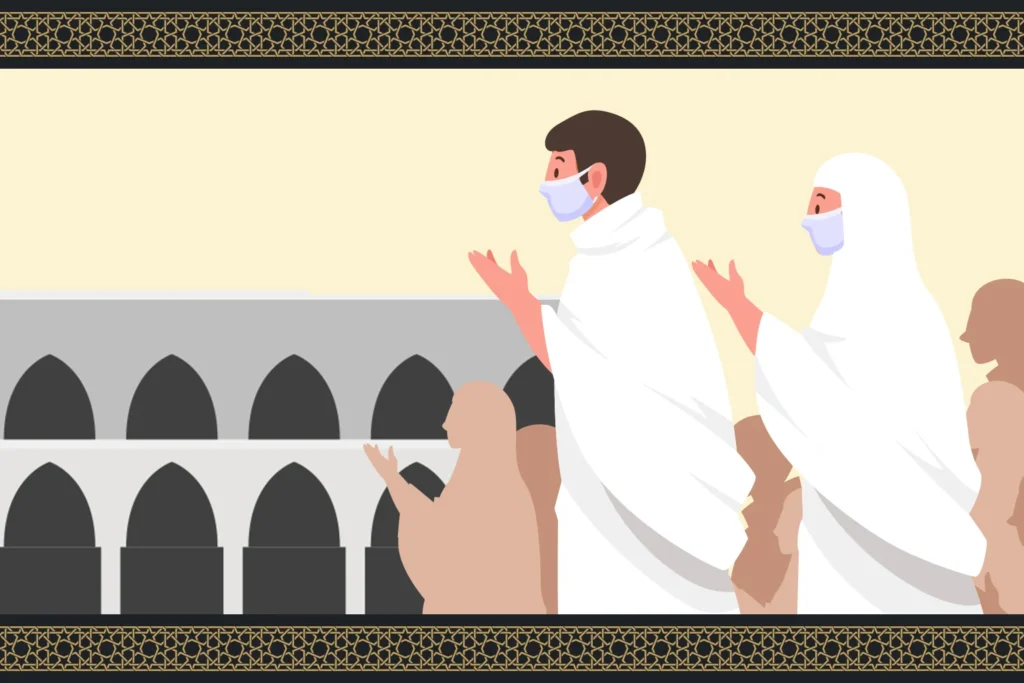
Wear the Ihram garments. For men: two white, unstitched sheets — one wrapped around the waist (Izar) and one draped over the shoulders (Rida). No underwear, socks, or head covering. For women: any modest, loose clothing that covers the body. There is no specific color requirement. Women should not cover their faces with a Niqab or their hands with gloves while in Ihram, though they may drape a cloth over their face if non-Mahram men pass closely.
Make your intention (Niyyah). Before crossing the Miqat, declare your intention in your heart and say:
لَبَّيْكَ اللَّهُمَّ عُمْرَةً “Labbayk Allahumma Umratan” (Here I am, O Allah, for Umrah)
Recite the Talbiyah. From this point until you begin Tawaf, recite the Talbiyah frequently:
لَبَّيْكَ اللَّهُمَّ لَبَّيْكَ، لَبَّيْكَ لَا شَرِيكَ لَكَ لَبَّيْكَ، إِنَّ الْحَمْدَ وَالنِّعْمَةَ لَكَ وَالْمُلْكَ، لَا شَرِيكَ لَكَ
“Labbayk Allahumma labbayk, labbayk la shareeka laka labbayk. Innal hamda wan-ni’mata laka wal-mulk, la shareeka lak.”
(Here I am, O Allah, here I am. Here I am, You have no partner, here I am. Indeed all praise, favor, and sovereignty belong to You. You have no partner.)
What is prohibited during Ihram:
For both men and women: cutting hair or nails, applying perfume or scented products, hunting, sexual relations, arguing, and committing sins. For men specifically: covering the head and wearing stitched clothing. For women specifically: covering the face with a Niqab or hands with gloves.
Step 2: Tawaf — Circling the Kaaba
When you arrive at Masjid al-Haram and see the Kaaba for the first time, pause. This is one of the most powerful moments in a Muslim’s life — and your Duas at first sight of the Kaaba are especially accepted. Ask Allah for whatever is in your heart.
How to perform Tawaf:
Start at Hajar al-Aswad (the Black Stone). Face the Black Stone, raise your right hand toward it, and say:
بِسْمِ اللَّهِ، اللَّهُ أَكْبَرُ “Bismillahi, Allahu Akbar”
If you can touch or kiss the Black Stone, do so. If the crowd is too dense (which is almost always the case), simply point toward it with your right hand from wherever you’re standing. The gesture carries the same reward.
Circle counter-clockwise. Walk around the Kaaba with the Kaaba on your left side. Complete seven full rounds, starting and ending at the Black Stone.
Ramal (men only, first 3 rounds): Men walk briskly with short steps and puffed-out chests during the first three rounds. The remaining four rounds are walked at a normal pace.
Idtiba (men only): During Tawaf, men uncover the right shoulder by tucking the upper Ihram sheet under the right arm. Re-cover the shoulder after Tawaf is complete.
Duas during Tawaf: There is no fixed Dua prescribed for each round — a common misconception. You may recite any Dua, any Surah of the Quran, or any Dhikr. The best practice is to make personal Duas in your own language, recite Quran from memory, and include this Dua between the Yemeni Corner and the Black Stone:
رَبَّنَا آتِنَا فِي الدُّنْيَا حَسَنَةً وَفِي الْآخِرَةِ حَسَنَةً وَقِنَا عَذَابَ النَّارِ “Rabbana atina fid-dunya hasanatan wa fil-akhirati hasanatan wa qina adhaban-nar” (Our Lord, give us good in this world and good in the Hereafter, and save us from the punishment of the Fire.)
After Tawaf: Pray 2 Rak’at behind Maqam Ibrahim (the Station of Ibrahim) if possible, or anywhere in the mosque if the area is crowded. Recite Surah Al-Kafirun in the first Rak’ah and Surah Al-Ikhlas in the second.
Then drink Zamzam water. The Prophet ﷺ said: “The water of Zamzam is for whatever purpose it is drunk for.” Make Dua while drinking.
Step 3: Sa’i — Walking Between Safa and Marwah
Sa’i commemorates Hajar (AS), the wife of Prophet Ibrahim (AS), who ran between these two hills searching for water for her infant son Ismail (AS) — until Allah caused Zamzam to spring from the ground.
How to perform Sa’i:
Start at Safa. When you reach the hill of Safa, face the Kaaba and recite:
إِنَّ الصَّفَا وَالْمَرْوَةَ مِن شَعَائِرِ اللَّهِ “Innas-Safa wal-Marwata min sha’a’irillah” (Indeed Safa and Marwah are among the symbols of Allah.) [Quran 2:158]
Then make Dua facing the Kaaba.
Walk from Safa to Marwah. This is one lap. Walk at a normal pace. Men walk briskly (jog lightly) between the two green markers — women walk at their normal pace throughout.
Walk from Marwah back to Safa. This is the second lap.
Complete 7 laps total. Safa to Marwah is 1. Marwah to Safa is 2. You end on Marwah after the 7th lap.
Duas during Sa’i: Like Tawaf, there are no fixed Duas for each lap. Recite Quran, make personal Duas, and keep your heart focused on Allah. The walking itself is worship — every step is recorded.
Step 4: Halq or Taqsir — Hair Cutting
This is the final step that releases you from the state of Ihram.
For men: Halq (shaving the entire head) is preferred and carries more reward. Taqsir (trimming hair evenly from all parts of the head, at least a fingertip’s length) is also permissible.
For women: Taqsir only — cutting approximately a fingertip’s length from the ends of the hair. Women do not shave their heads.
After this step, your Umrah is complete. All Ihram restrictions are lifted. You may change into regular clothes, apply perfume, and resume normal activities.
Common Mistakes to Avoid
Entering Ihram after passing the Miqat. You must enter the state of Ihram before crossing the Miqat boundary. If you’re flying into Jeddah, you enter Ihram on the plane before passing the Miqat point — not after landing.
Believing there are specific Duas for each Tawaf round. There are no authentically prescribed Duas for specific rounds. The booklets sold near the Haram with “Dua for round 1, Dua for round 2” are compilations, not Sunnah. Make any Dua in any language.
Pushing through crowds to touch the Black Stone. Pointing toward it from a distance carries the same reward as touching it. Shoving and elbowing other pilgrims is sinful — don’t let eagerness override basic etiquette.
Rushing through Sa’i. Some pilgrims treat Sa’i as a race to finish. Walk calmly, make Dua with focus, and remember you are retracing the steps of Hajar (AS) — a woman whose trust in Allah brought water from barren ground.
Losing count of Tawaf or Sa’i rounds. If you’re unsure, take the lower number and complete the round. Using a phone counter or tasbih helps.
Rules Specific to Women
Women performing Umrah follow the same four steps with a few differences: Ihram clothing is regular modest dress (no specific garment required), there’s no Ramal during Tawaf (women walk at normal pace for all 7 rounds), there’s no jogging between the green markers during Sa’i, and Taqsir (trimming a small portion of hair) is the only option — no Halq.
Menstruation: A woman who begins her period before completing Tawaf should wait until she is pure, make Ghusl, and then perform Tawaf. She may perform all other rituals (Sa’i, Dua, Dhikr) during her period — only Tawaf requires a state of purity.
Prepare Before You Go
The difference between a spiritually transformative Umrah and an overwhelming, confusing one is preparation. Pilgrims who arrive knowing the steps, the Duas, and enough Quran to recite during Tawaf experience Umrah at a completely different level.
What to prepare before your trip:
Memorize the Talbiyah and the key Duas (listed above). Memorize at least Juz Amma (the short Surahs) so you have Quran to recite during the long Tawaf and Sa’i. Learn the proper way to perform Wudu and Salah — you’ll pray 2 Rak’at after Tawaf and pray the 5 daily prayers in Masjid al-Haram. Understand the Fiqh rules of Ihram (what is permitted and what is not).
Our Islamic Course for Beginners and Learn Salah course cover all of this. Many students enroll specifically to prepare for Hajj or Umrah — so they arrive in Makkah confident in their worship, not guessing.
Book 3 Free Trial Classes →
→ Islamic Course for Beginners → Learn Salah Course → All Courses
FAQs
What is the difference between Hajj and Umrah? Hajj is obligatory (Fard) once in a lifetime for every Muslim who is physically and financially able, and it can only be performed during specific days of Dhul Hijjah (the 12th month). Umrah is a Sunnah that can be performed any time of the year and involves 4 rituals: Ihram, Tawaf, Sa’i, and Halq/Taqsir. Hajj includes additional rituals like standing at Arafat, staying at Muzdalifah, and stoning at Jamarat.
How long does Umrah take to complete? The rituals themselves — Tawaf, Sa’i, and hair cutting — can be completed in 3–5 hours depending on crowd levels. During Ramadan or peak season, crowds may extend this. The entire trip from the US (including travel days) typically lasts 7–14 days.
Can women perform Umrah without a Mahram? According to the majority of scholars, a woman needs a Mahram (male relative) to travel for Hajj or Umrah. Some scholars, including those of the Shafi’i and Maliki schools, permit women to travel with a trustworthy group of women. Saudi regulations may vary — check current visa requirements before booking.
When is the best time to perform Umrah? Umrah during Ramadan carries the reward of a Hajj, according to authentic Hadith. However, Ramadan is also the most crowded period. For a calmer experience with shorter wait times, consider the months of Rajab, Shawwal, or Rabi al-Awwal.
What Surahs should I memorize before Umrah? At minimum, memorize Surah Al-Fatiha, Al-Ikhlas, Al-Falaq, An-Naas, and Al-Kafirun (needed for the 2 Rak’at after Tawaf). Ideally, memorize as much of Juz Amma as possible so you have a variety of Surahs to recite during your seven rounds of Tawaf and seven laps of Sa’i.
Do I need to learn Arabic before performing Umrah? You don’t need to speak Arabic, but you should be able to recite the Talbiyah, the key Duas, and Quran in Arabic. Our Noorani Qaida and Learn Salah courses teach the Arabic recitations you need for both daily prayer and Umrah.
What happens if I make a mistake during Umrah? Minor mistakes (losing count of Tawaf rounds, forgetting a Dua) don’t invalidate your Umrah. If you’re unsure of your count, take the lower number and complete the extra round. For major violations of Ihram (applying perfume, cutting nails), a Fidyah (compensation) may be required — consult a scholar for your specific situation.
How can I prepare for Umrah spiritually? Learn the rituals and Duas beforehand so you’re not reading from a booklet during Tawaf. Memorize Quran — the more you carry in your heart, the more meaningful your Tawaf becomes. Learn the stories behind the rituals (Ibrahim AS, Hajar AS, Ismail AS) so each step feels connected to its purpose. And begin making Dua now — list everything you want to ask Allah for, so you’re ready when you stand before the Kaaba.