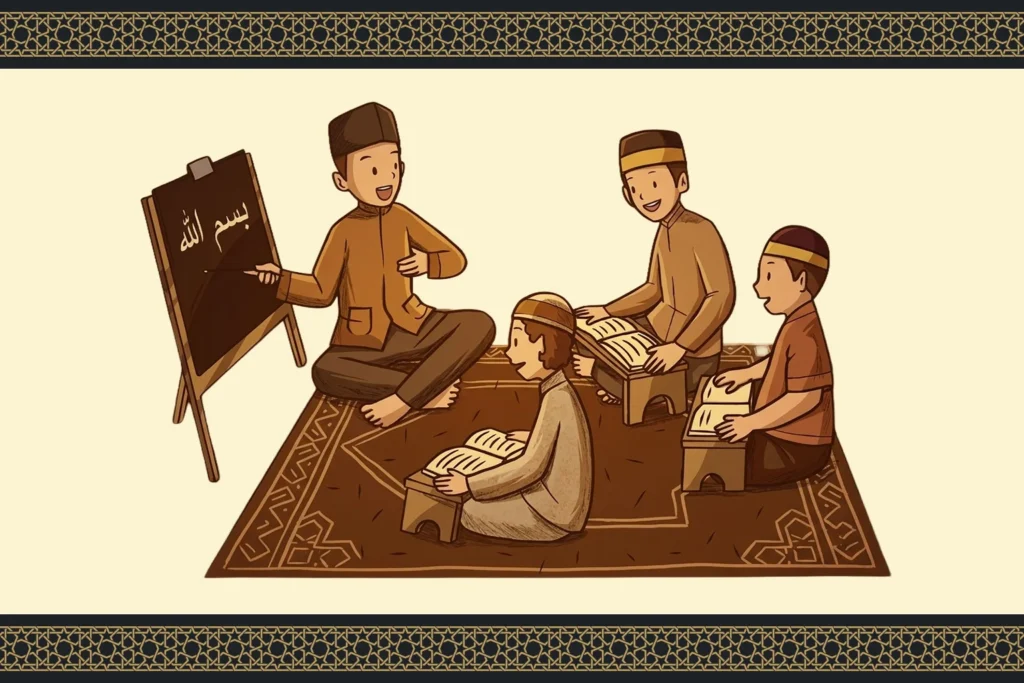
Tajweed comes from the Arabic root j-w-d, meaning “to make better” or “to beautify.” In Quran recitation, Tajweed is the set of rules that govern how every letter is pronounced — where the sound originates, how long it’s held, whether it merges with the next letter, and when to pause.
Without Tajweed, even a slight mispronunciation can change the meaning of a word. The difference between qalb (heart) and kalb (dog) is the depth of a single letter. Tajweed prevents these errors and preserves the Quran exactly as it was recited by the Prophet ﷺ, who received it from Jibreel (AS), who received it from Allah.
A’ishah (may Allah be pleased with her) narrated: “One who recites the Quran beautifully, smoothly, and precisely will be in the company of the noble angels. As for the one who recites with difficulty, stammering or stumbling through its verses, they will have twice that reward.” (Sahih al-Bukhari)
Two rewards for struggling — not one. Allah doesn’t expect perfection from a learner. He rewards the effort itself.
The 12 Core Tajweed Rules
Every Tajweed rule falls into one of these categories. This guide covers each with its sub-rules and Arabic examples. If you’re a beginner, don’t try to memorize all 12 at once — learn them in order, practice each with your teacher, and move forward only when it feels natural.
1. Noon Sakinah & Tanween
This is the most commonly applied Tajweed rule. It governs what happens when you encounter a Noon with sukoon (نْ) or a letter carrying Tanween (the double vowel marks: ـًـ ـٍـ ـٌـ that produce an “n” sound).
What you do with that “n” sound depends entirely on which letter comes next. There are four possibilities:
Idhaar (إظهار) — “To make clear”
If Noon Sakinah or Tanween is followed by one of these 6 throat letters: ء ه ع ح غ خ — pronounce the Noon clearly, with no nasalization (ghunnah).
These six letters all originate from the throat, which is far enough from the nose that the nasal sound doesn’t carry. So the Noon stays clean and distinct.
Idghaam (إدغام) — “To merge”
If one of these 4 letters follows: ي ن م و — the Noon merges into the next letter with a 2-beat ghunnah (nasal hum). The Noon essentially disappears, and the ghunnah transfers to the following letter.
If ل or ر follows, the Noon merges without ghunnah — a clean, complete merge with no nasal sound.
Iqlaab (إقلاب) — “To convert”
If ب follows the Noon Sakinah or Tanween, convert the Noon sound into a Meem (م) with ghunnah, then pronounce the ب. The tongue and lips position for Meem before releasing into the Ba.
Ikhfaa (إخفاء) — “To hide”
For the remaining 15 letters — ت ث ج د ذ س ش ص ض ط ظ ف ق ك — hide the Noon sound. Don’t pronounce it fully (that would be Idhaar) and don’t merge it completely (that would be Idghaam). Instead, produce a subtle ghunnah while shaping your mouth to prepare for the next letter.
The degree of hiding varies depending on where the following letter originates in the mouth. Letters closer to the Noon’s articulation point get heavier Ikhfaa; letters further away get lighter Ikhfaa. This subtlety is where a teacher’s ear becomes essential — you can’t hear these distinctions in your own recitation.
→ Deep dive: Noon Sakinah & Tanween Rules explained
2. Noon & Meem Mushaddad
When a Noon (ن) or Meem (م) carries a Shaddah (ّ), hold a 2-beat ghunnah on that letter. The Shaddah doubles the letter, and the ghunnah is the nasal resonance you produce during that hold.
ثُمَّ = thum-mma (hold the Meem with ghunnah for 2 beats) إِنَّ = in-nna (hold the Noon with ghunnah for 2 beats)
Be careful not to extend the letter’s sound itself — only the ghunnah. The letter stays the same length; the nasal hum carries it.
3. Meem Sakinah
Similar structure to Noon Sakinah rules, but with only three sub-rules:
Ikhfaa Shafawi (إخفاء شفوي) — Oral hiding
When ب follows a Meem Sakinah, hide the Meem with a light ghunnah before pronouncing the Ba. Both letters are labial (lip letters), so the hiding happens naturally at the lips.
Idghaam Shafawi (إدغام شفوي) — Oral merging
When another م follows a Meem Sakinah, merge the two Meems together with a 2-beat ghunnah. Two Meems become one extended Meem with nasal resonance.
Idhaar Shafawi (إظهار شفوي) — Oral clarity
For all other letters following Meem Sakinah, pronounce the Meem clearly — no ghunnah, no merging. Simply say the Meem and move cleanly to the next letter.
Example: أَلَمْ تَرَ = alam tara (Meem is clear, no ghunnah before the Taa)
→ Deep dive: Meem Sakinah Rules explained
4. Qalqalah (القلقلة) — “Echoing”
Five letters produce a bouncing echo when they carry a Sukoon (are not followed by a vowel): ق ط ب ج د
A memory aid: these five letters spell قُطْبُ جَدّ.
The echo has three levels of intensity:
Minor Qalqalah — the letter appears in the middle of a word with Sukoon. The echo is subtle, a quick bounce before continuing to the next letter. Example: تَجْرِي = tajree (the Jeem bounces lightly)
Medium Qalqalah — you stop on a word that ends with a Qalqalah letter (no Shaddah). The echo is more noticeable because there’s no following letter to absorb it. Example: اللَّهُ الصَّمَدُ = Allahus-samad (the Dal at the end echoes)
Major Qalqalah — you stop on a word ending with a Qalqalah letter that carries Shaddah. The echo is strongest here — a pronounced, jerking bounce. Example: وَتَبَّ = wa tabb (the doubled Ba produces a strong echo)
5. Al-Madd (المد) — Elongation
Madd means stretching a vowel sound longer than its natural length. The three Madd letters are: ا و ي
How long you stretch depends on what comes after the Madd letter. Length is measured in “beats” (harakaat):
Natural Madd (المد الطبيعي) — 2 beats
When a Madd letter is followed by a regular letter (no Hamza, no Sukoon), stretch for exactly 2 beats. This is the default, baseline elongation.
Examples: دِينُكُمْ = dee-nukum (the Ya stretches 2 beats) يَا = yaa (the Alif stretches 2 beats) عَابِدُونَ = aaa-bi-doona (the Alif after Ain stretches 2 beats)
When stopping on a word ending in Tanween Fathah, the Tanween converts to an Alif Madd: أَفْوَاجًا = afwaa-jaa (the final Tanween becomes a 2-beat Alif)
Connected Madd (المد المتصل) — 4–5 beats
When a Hamza follows a Madd letter within the same word, stretch for 4 or 5 beats. Example: جَاءَ = jaaaa-a (the Alif before Hamza stretches 4–5 beats)
Separated Madd (المد المنفصل) — 4–5 beats
When a word ends in a Madd letter and the next word starts with a Hamza, stretch for 4 or 5 beats. Example: إِذَا جَاءَ = idhaa jaaaa-a
Compulsory Madd (المد اللازم) — 6 beats
When a letter with Shaddah or Sukoon follows a Madd letter, stretch for a full 6 beats. This is the longest Madd and is mandatory — no flexibility. Example: وَلَا الضَّالِّينَ = wa lad-daaaaaaalleeeen (the Alif before the Shaddah-carrying Laam stretches 6 beats)
Flexible Madd (المد العارض للسكون) — 2, 4, or 6 beats
When you choose to stop on a word and the last letter becomes Sakin (because you stopped), you may stretch the preceding Madd letter for 2, 4, or 6 beats — your choice. The minimum is always 2.
→ Deep dive: Madd Rules in Tajweed explained
6. Makharij al-Huruf — Articulation Points
Every Arabic letter has a specific exit point (Makhraj) in the mouth, throat, or nasal passage. There are 17 articulation points grouped into 5 regions: the throat, the tongue, the lips, the nasal passage, and the empty space in the mouth (Jawf).
Makharij is arguably the most important Tajweed topic because every other rule depends on pronouncing letters correctly in the first place. If your Ain (ع) sounds like your Alif (ا), no amount of Noon Sakinah rules will fix your recitation.
This topic deserves its own detailed guide: → Complete Makharij al-Huruf Guide
7. Waqf — Stopping Rules
Waqf governs where you can pause, where you must stop, and where you should not stop during recitation. The Mushaf uses symbols to guide you:
(Waqf Taam) — End of a verse. Full stop required. مـ (Waqf Lazim) — Mandatory stop. You must pause here to preserve meaning. ج (Waqf Ja’iz) — Permissible stop. You may pause or continue. لا (La Taqif) — Do not stop. Pausing here would change the meaning. ∴ (Mu’aanaqah) — Stop at one of two marked points, but not both.
Stopping at the wrong place can change the meaning of an entire passage. A teacher trains your instinct for where to breathe and where to push through — this is something audio recordings alone can’t teach, because every reciter’s lung capacity is different.
Do You Have to Learn Tajweed?
Reading the Quran without Tajweed is not haram. The Quran does not explicitly mandate Tajweed as a Fard (obligation) in the way it mandates Salah or fasting.
However, scholars agree on this: if you know a Tajweed rule and deliberately ignore it during recitation, that is a mistake you’re choosing to make. And if your mispronunciation changes the meaning of an ayah, the responsibility is yours.
For a beginner who is actively learning, mistakes are expected and forgiven — Allah rewards the struggle itself. But the goal should always be to recite as accurately as you can with whatever knowledge you currently have, and to keep improving.
The practical answer: you don’t need to master every Tajweed rule before you open the Quran. But you should be learning Tajweed alongside your reading, not instead of it.
→ Importance of Tajweed in Quran recitation
How Long Does It Take to Learn Tajweed?
Most students who take regular classes (2–3 sessions per week) reach a comfortable Tajweed level in 6–12 months. This means they know the core rules, apply them during recitation without constant reminders, and can self-correct most errors.
Full mastery — the level needed for Ijazah certification — takes longer, typically 1–2 years of intensive study with a Qari who holds their own Ijazah.
The timeline depends on three factors: your current reading level (students who’ve completed Noorani Qaida progress faster), how many classes you take per week (3+ is recommended for Tajweed), and how much you practice between sessions.
→ How long does it take to learn Tajweed? — detailed timeline
Learn Tajweed With a Certified Teacher
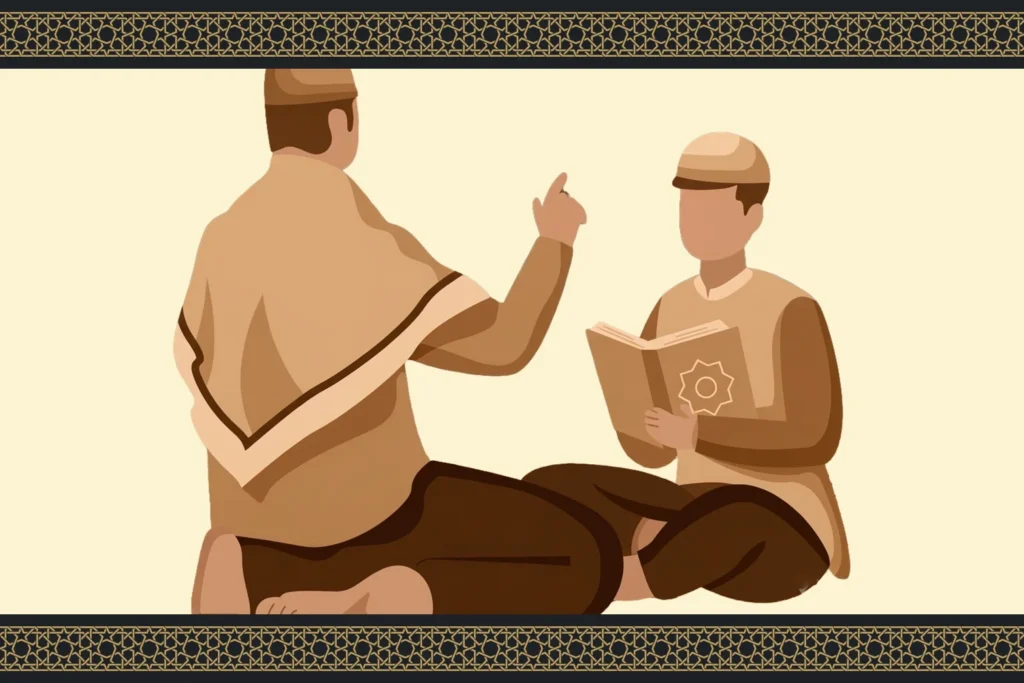
Tajweed is a listening skill more than a reading skill. You can study the rules from a book or a blog post like this one — but you cannot hear your own mistakes. The difference between a correct Ikhfaa and an incorrect one is subtle enough that your own ears will miss it. A teacher’s ears won’t.
In a 1-on-1 online Tajweed class, you recite while your teacher listens and corrects in real time. There’s no group to hide behind and no errors that slip past. Over weeks and months, the corrections become instincts — you stop thinking about where to apply ghunnah and start doing it automatically.
Recommended plan: Our Standard plan (3 classes/week, $40/month) or Plus plan (4 classes/week, $45/month) gives you enough practice frequency for Tajweed rules to stick between sessions.
3 free trial classes. No credit card. No obligation.
Book Your Free Trial →
→ Tajweed ul Quran Course — full details
FAQs
What are the basic Tajweed rules? The core Tajweed rules cover Noon Sakinah & Tanween (4 sub-rules for the “n” sound), Meem Sakinah (3 sub-rules for the “m” sound), Qalqalah (echoing on 5 specific letters), Madd (elongation rules), Makharij al-Huruf (articulation points for all Arabic letters), and Waqf (stopping and pausing rules).
How many Tajweed rules are there? There are 12 core Tajweed rule categories, each with its own sub-rules. The main categories are Noon Sakinah & Tanween, Noon & Meem Mushaddad, Meem Sakinah, Qalqalah, Al-Madd (with multiple sub-types), Makharij al-Huruf, Sifaat al-Huruf, and Waqf rules.
Can I read the Quran without knowing Tajweed? Yes — reading without Tajweed is not haram. However, Tajweed prevents mispronunciations that can change meaning, so learning it alongside your reading is strongly recommended. Allah rewards effort, so a beginner who recites imperfectly while actively learning is doubly rewarded.
How long does it take to learn Tajweed? Most students reach a comfortable Tajweed level in 6–12 months with 2–3 classes per week. Full mastery for Ijazah certification typically takes 1–2 years of dedicated study with a certified Qari.
What is the difference between Tajweed and Qirat? Tajweed is the set of pronunciation rules that apply to all Quran recitation. Qirat refers to the different authenticated modes of recitation (there are 10), each with slight variations in pronunciation, voweling, and word forms. Tajweed rules apply within every Qirat. Read more →
Do I need to learn Arabic before learning Tajweed? No. Tajweed is learned alongside Quran reading, not as a separate Arabic language course. Most students begin Tajweed after completing Noorani Qaida, which teaches Arabic letter recognition and basic pronunciation.
What is ghunnah in Tajweed? Ghunnah is the nasal sound produced when air passes through the nose during certain letter combinations. It’s most commonly applied during Noon Sakinah rules (Idghaam, Ikhfaa) and Meem Sakinah rules (Ikhfaa Shafawi, Idghaam Shafawi). A standard ghunnah lasts 2 beats.
How much do online Tajweed classes cost? Our plans range from $30/month (2 classes/week) to $55/month (5 classes/week). For Tajweed, we recommend at least 3 classes per week ($40/month) to maintain momentum between sessions. Every plan includes 3 free trial classes. See full pricing →