The short answer: 4 to 7 years old is the ideal window to begin structured Quran learning. Children in this age range absorb Arabic sounds naturally, memorize quickly, and form habits that stay with them into adulthood.
But “ideal” doesn’t mean “only.” A 3-year-old can start with listening. An 8-year-old can catch up quickly with the right teacher. And adults who never learned as children start — and succeed — every day.
The real question isn’t what age — it’s what to teach at each age. That’s what this guide covers.
Ages 3–4: Listening and Love (Not Lessons)
At this stage, formal classes are too early for most children. Their attention span is 5–10 minutes, they can’t sit still for structured instruction, and pushing too hard risks creating a negative association with the Quran before they’ve even begun.
What works at this age:
Play Quran recitation at home daily — during meals, in the car, before bedtime. The goal is familiarity, not comprehension. Your child’s brain is absorbing the rhythm, melody, and sound patterns of Arabic even when they seem to be playing with their toys and ignoring it.
Teach 2–3 short Duas through daily repetition: Dua before eating, Dua before sleeping, Bismillah. These are short enough for a 3-year-old to mimic and feel proud of.
Point out Arabic letters casually — on signs, in books, on their clothes. Don’t drill them. Just name them: “Look, that’s an Alif!” This plants seeds of letter recognition without the pressure of a lesson.
What to avoid: formal Qaida classes, memorization expectations, sitting your child down for 30-minute sessions. If your 3-year-old resists, you’re not behind — you’re just not at the right stage yet.
The one exception: some 4-year-olds are genuinely ready for structured learning — they can sit, focus, and enjoy repetition. If your child asks to learn like an older sibling or shows interest in the Mushaf, follow their lead. Readiness varies by child, not by birthday.
Ages 4–7: The Golden Window
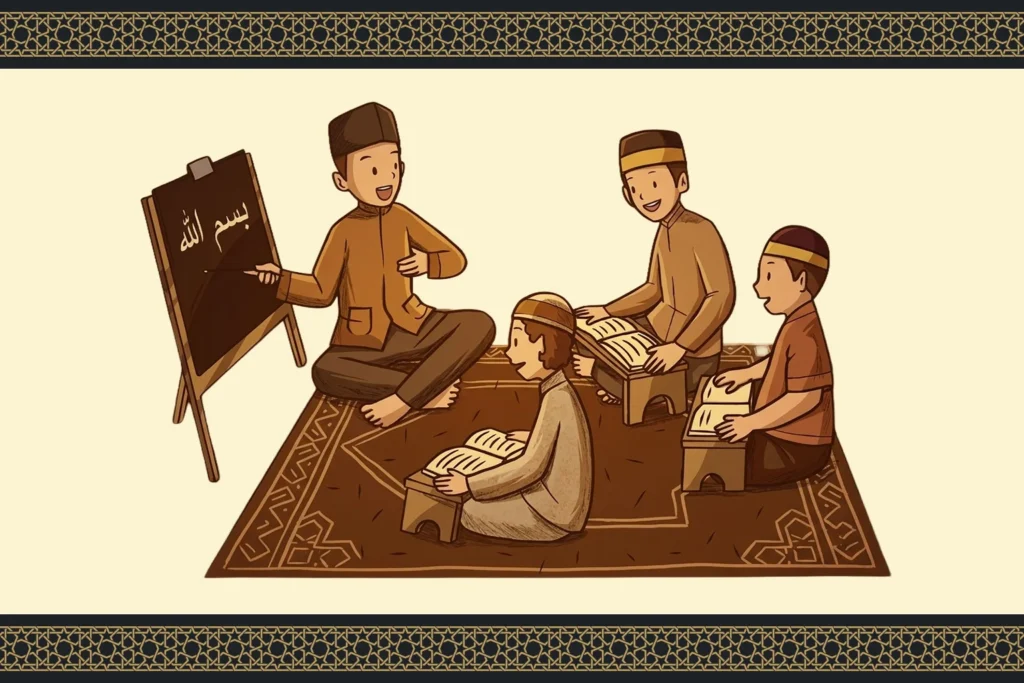
This is the stage most Quran teachers and Islamic educators recommend for starting structured classes. Here’s why it works so well:
Memory is at its peak. Children in this age range memorize faster than at any other point in their lives. The brain is still developing rapidly, forming new neural pathways with every repetition. A 5-year-old who learns Surah Al-Fatiha will retain it with far less revision than a 15-year-old learning the same Surah.
Pronunciation is still flexible. Arabic has sounds that don’t exist in English — the deep Ha (ح), the heavy Dhad (ض), the guttural Ain (ع). A child’s vocal muscles are still forming, so they can learn these sounds naturally through imitation. An adult has to consciously retrain muscles that have been speaking English for 30 years.
Habit formation is effortless. A child who starts Quran at age 5 and practices daily doesn’t experience it as “extra work.” It’s just part of their day, like brushing teeth. By the time they’re 10, Quran reading is automatic. A child who starts at 12 has to carve out time from an already-crowded schedule of school, sports, and friends — and the Quran competes for attention instead of being part of the routine.
What to teach at this stage:
Start with Noorani Qaida — the foundational book that teaches Arabic letters, sounds, vowel marks, and letter connections. Most children complete it in 3–6 months with 2–3 classes per week.
After Qaida, move to Quran Reading — short Surahs from Juz Amma first (Al-Fatiha, Al-Ikhlas, Al-Falaq, An-Naas), then gradually longer passages.
Introduce basic Tajweed rules naturally during reading — your teacher will correct pronunciation in real time rather than teaching rules abstractly.
Session length: 20–30 minutes is enough for this age group. Longer sessions lead to fatigue and resistance. Two to three sessions per week keeps progress steady without overwhelming them.
The parent’s role: you don’t need to be a Quran teacher yourself. Your job is consistency — making sure your child shows up to class, practices for 5–10 minutes between sessions, and associates Quran time with encouragement rather than punishment. Never use Quran memorization as a punishment or consequence for bad behavior. The Quran should always be connected to praise, pride, and closeness to Allah.
Ages 7–12: Catching Up Is Faster Than You Think
If your child hasn’t started Quran learning by age 7, you’re not late — you’re actually in a strong position. Children at this age bring skills that younger kids don’t have: they can read in English (so the concept of “reading” isn’t new), they understand instructions, they can focus for longer sessions, and they can ask questions when something doesn’t make sense.
What’s different at this age:
Pronunciation takes more conscious effort. A 5-year-old imitates sounds unconsciously. A 9-year-old needs their teacher to explain where the tongue goes and how the throat shapes the letter. This takes slightly longer at first but produces the same result.
Memorization is still strong — not as effortless as age 5, but far easier than it will be at 25. If Hifz is a goal, starting by age 10 gives your child a realistic path to completing memorization by their mid-teens.
Understanding becomes an asset. Older children can grasp the meaning of what they’re reading, which makes memorization more meaningful and retention stronger. A child who understands that Surah Al-Fatiha is a conversation with Allah during every prayer connects to it differently than one who memorized it as pure sounds.
Recommended starting point: Still Noorani Qaida, even for a 10-year-old who has never learned Arabic. The temptation is to skip the basics and jump straight to reading — but this creates pronunciation gaps that become permanent. A 10-year-old finishes Qaida faster than a 5-year-old (often in 2–3 months), so the time investment is minimal and the foundation is solid.
Teenagers: Different Challenges, Real Advantages
Teens face a unique set of obstacles: academic pressure, social distractions, resistance to anything that feels like “another class,” and the self-consciousness of being a beginner when they feel they “should” already know this.
What works with teenagers:
Frame Quran learning as their own choice, not a parental mandate. A teen who enrolls because they want to is far more committed than one who’s forced.
1-on-1 online classes eliminate the embarrassment of learning basics in front of peers. It’s just them and their teacher — no one else knows they’re starting from Alif.
Connect the Quran to their existing interests: if they care about Arabic calligraphy, show them the beauty of Quranic script. If they’re interested in history, show them how Tafseer unlocks the stories behind the verses.
Set realistic expectations: 2 classes per week is enough to build momentum without competing with homework and exams.
Adults: It’s Not Too Late — Here’s Proof
The most common reason adults don’t start learning the Quran is embarrassment. They feel they should have learned as children. They imagine sitting in a class full of kids, struggling with basic letters while 6-year-olds read fluently around them.
Online 1-on-1 classes eliminate this entirely. It’s just you and your teacher. No classroom. No children. No audience for your mistakes.
Adults memorize slower than children initially — but they compensate with discipline, motivation, and the ability to understand meaning. Many adults who start Hifz in their 30s and 40s complete it, because they bring a level of commitment that a 7-year-old simply can’t.
The Prophet ﷺ said: “The one who recites the Quran while struggling receives two rewards.” Your struggle as an adult learner is not a disadvantage — it’s a doubled reward.
How Online Classes Work for Every Age
Ages 4–6 — 20–30 min sessions — Starter 2x/week $30/month — Noorani Qaida
Ages 7–12 — 30 min sessions — Standard 3x/week $40/month — Noorani Qaida
Teens 13+ — 30 min sessions — Standard 3x/week $40/month — Qaida or Reading
Adults — 30 min sessions — Standard or Plus $40–$45/month — Qaida or Reading
Every plan includes 1-on-1 sessions with a teacher matched to your child’s age and level, flexible scheduling around school and activities, and 3 free trial classes before any payment.
FAQs
What is the best age to start learning the Quran? The ideal age for structured Quran learning is 4–7 years. Children in this range memorize quickly, absorb Arabic pronunciation naturally, and form daily habits easily. However, learning can begin at any age — informal listening and Duas can start as early as age 3, and adults successfully start their journey at every stage of life.
Can a 3-year-old start Quran classes? Formal classes are usually too early at age 3. Instead, play Quran recitation at home daily, teach 2–3 simple Duas through repetition, and point out Arabic letters casually. This builds familiarity and love without pressure. Some 4-year-olds may be ready for structured Noorani Qaida lessons if they show interest and can focus for 15–20 minutes.
My child is 10 and hasn’t started — is it too late? Not at all. A 10-year-old actually progresses faster through Noorani Qaida than a 5-year-old because they already understand the concept of reading and can follow instructions. Most 10-year-olds complete Qaida in 2–3 months and move to Quran reading quickly. The pronunciation gap from starting later is easily corrected with a qualified teacher.
Should my child start with Noorani Qaida or directly with the Quran? Always start with Noorani Qaida, regardless of age. Skipping Qaida means skipping Arabic letter recognition, pronunciation fundamentals, and basic Tajweed — which creates gaps that become harder to fix later. Qaida is the foundation, and a strong foundation makes everything after it easier and faster.
How many classes per week does my child need? Two to three classes per week is sufficient for most children. More than that can lead to fatigue, especially for children under 7. The key is consistency — 2 classes every week for a year produces better results than 5 classes per week for 2 months followed by quitting.
Can my child learn Quran online at age 5? Yes. Online 1-on-1 classes work well for children as young as 4–5 when sessions are kept to 20–30 minutes. The 1-on-1 format actually benefits young children because they get 100% of the teacher’s attention, unlike a group masjid class where they might sit idle for most of the session.
How long does it take for a child to learn to read the Quran? Most children who start Noorani Qaida at age 5–6 with 2–3 classes per week complete it in 3–6 months, then spend 6–12 months building Quran reading fluency. By age 7–8, a child who started at 5 can typically read the Quran independently with basic Tajweed.
Is it better to learn at a masjid or online? Both can be effective. The advantage of online is 1-on-1 attention (masjid classes are typically group settings with 10–20 children per teacher), flexible scheduling, and the ability to choose a teacher matched to your child’s needs. The advantage of masjid is the social environment and community connection. Many families use online classes for Quran instruction and masjid for Islamic socialization.