





Register Now
Fill out this form to get a quote within 24 hours.


Life is full of moments that leave us feeling overwhelmed — financial pressure, relationship struggles, health concerns, uncertainty about the future. As Muslims, we are never left without a response to these moments. Allah (SWT) has given us one of the most powerful tools imaginable: dua (supplication).
The Prophet Muhammad (ﷺ) said: “Dua is the essence of worship.” (Tirmidhi)
When anxiety grips the heart and stress weighs down the mind, turning to Allah in sincere supplication is not just a spiritual act — it is the most practical one. Islam has always acknowledged the reality of human distress, and the Quran and Sunnah are filled with specific duas taught directly by Allah or by the Prophet (ﷺ) for exactly these moments.
In this guide, you will find the most important and most searched duas for anxiety and stress — complete with Arabic text, transliteration, English meaning, source, and guidance on when and how to recite them.
Before diving into the duas themselves, it is worth understanding what Islam says about anxiety and stress. These are not signs of weak faith. The Quran acknowledges human worry directly:
“Verily, with hardship comes ease.” — Surah Ash-Sharh (94:5–6)
Allah (SWT) repeats this promise twice in the same short surah — a divine emphasis that relief always follows difficulty. The Prophet (ﷺ) himself experienced grief, hardship, and distress, and Allah revealed guidance for him and for all of us.
Mental and emotional wellbeing is deeply embedded in Islamic teachings. Our Islamic Course for Beginners covers these foundational beliefs, helping students understand the Quran’s relationship with human emotion and the soul.
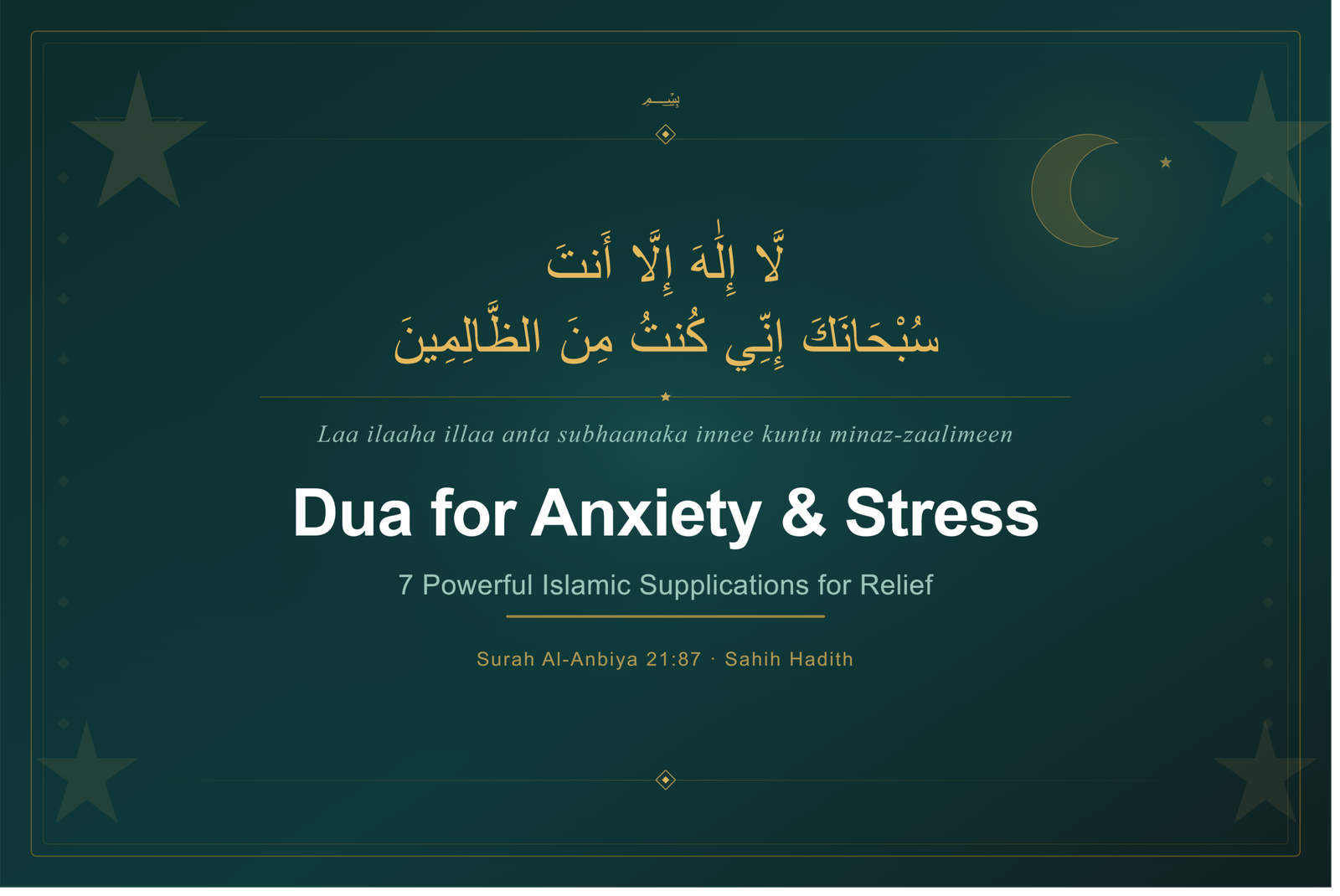
This is perhaps the single most searched dua in the Muslim world for anxiety, distress, and difficult times. It comes directly from the Quran — the supplication made by Prophet Yunus (ﷺ) from inside the whale, in total darkness, with no apparent way out.
Arabic:
لَّا إِلَٰهَ إِلَّا أَنتَ سُبْحَانَكَ إِنِّي كُنتُ مِنَ الظَّالِمِينَ
Transliteration:
Laa ilaaha illaa anta subhaanaka innee kuntu minaz-zaalimeen
English Meaning:
“There is none worthy of worship but You, glory be to You. Indeed, I have been of the wrongdoers.”
Source: Surah Al-Anbiya (21:87)
Hadith Reference: The Prophet (ﷺ) said: “No Muslim ever makes dua with these words in any matter except that Allah answers his prayer.” (Tirmidhi — classed as Hasan Sahih)
When to recite it: In any moment of crisis, darkness, or feeling trapped with no way forward. The beauty of this dua is that it is an admission of our own limitations combined with complete declaration of Allah’s perfection — exactly the mindset that opens the door of divine relief.
Dua e Karb refers to a specific supplication the Prophet (ﷺ) taught for moments of extreme distress. There are a few versions narrated in authentic hadith. Here is the most widely transmitted:
Arabic:
اللَّهُمَّ رَحْمَتَكَ أَرْجُو، فَلاَ تَكِلْنِي إِلَى نَفْسِي طَرْفَةَ عَيْنٍ، وَأَصْلِحْ لِي شَأْنِي كُلَّهُ، لاَ إِلَهَ إِلَّا أَنْتَ
Transliteration:
Allahumma rahmataka arjoo, falaa takilnee ilaa nafsee tarfata ‘aynin, wa aslih lee sha’nee kullahu, laa ilaaha illaa anta
English Meaning:
“O Allah, I hope for Your mercy. Do not leave me to myself even for the blink of an eye. Correct all of my affairs. There is none worthy of worship but You.”
Source: Abu Dawud (5090) — classed as Hasan by Al-Albani
When to recite it: Recite this when anxiety is so overwhelming that you feel you cannot manage on your own. It is an explicit request to Allah not to leave you to your own devices — a powerful acknowledgment of our dependence on Him.
The Prophet (ﷺ) taught a specific, comprehensive dua for someone experiencing both grief (huzn) and anxiety (hamm). This is one of the most detailed supplications in the Sunnah for emotional distress.
Arabic:
اللَّهُمَّ إِنِّي عَبْدُكَ وَابْنُ عَبْدِكَ وَابْنُ أَمَتِكَ، نَاصِيَتِي بِيَدِكَ، مَاضٍ فِيَّ حُكْمُكَ، عَدْلٌ فِيَّ قَضَاؤُكَ، أَسْأَلُكَ بِكُلِّ اسْمٍ هُوَ لَكَ سَمَّيْتَ بِهِ نَفْسَكَ، أَوْ عَلَّمْتَهُ أَحَدًا مِنْ خَلْقِكَ، أَوْ أَنْزَلْتَهُ فِي كِتَابِكَ، أَوِ اسْتَأْثَرْتَ بِهِ فِي عِلْمِ الْغَيْبِ عِنْدَكَ، أَنْ تَجْعَلَ الْقُرْآنَ رَبِيعَ قَلْبِي، وَنُورَ صَدْرِي، وَجَلَاءَ حُزْنِي، وَذَهَابَ هَمِّي
Transliteration:
Allahumma innee ‘abduka wa ibnu ‘abdika wa ibnu amatika, naasiyatee biyadika, maadin fiyya hukmuka, ‘adlun fiyya qadaa’uka, as’aluka bikulli ismin huwa laka sammayta bihi nafsaka, aw ‘allamtahu ahadan min khalqika, aw anzaltahu fee kitaabika, aw ista’tharta bihi fee ‘ilmil ghaybi ‘indaka, an taj’alal qur’aana rabee’a qalbee, wa noora sadree, wa jalaa’a huznee, wa dhahaaba hammee
English Meaning:
“O Allah, I am Your servant, the son of Your servant, the son of Your female servant. My forelock is in Your hand. Your command over me is forever executed and Your decree over me is just. I ask You by every name belonging to You which You named Yourself with, or revealed in Your Book, or You taught to any of Your creation, or You have preserved in the knowledge of the unseen with You — that You make the Quran the life of my heart and the light of my chest, and a departure for my sorrow and a release for my anxiety.”
Source: Ahmad (3712) — authenticated by Al-Albani in Silsilah As-Sahihah
Promise of the Prophet (ﷺ): “There is no-one who is afflicted by distress and grief, and says this, but Allah will take away his distress and grief, and replace it with joy.” (Reported by Ibn Masood)
This is one of the most profound duas in the Sunnah. Notice how it asks Allah to make the Quran itself the cure — a beautiful reminder that deep engagement with the Quran is itself a treatment for anxiety. Our Quran Tafseer Course helps you go beyond recitation and understand the Quran’s meanings deeply — a step that enriches your dua and your relationship with Allah.
Arabic:
حَسْبِيَ اللَّهُ لَا إِلَهَ إِلَّا هُوَ عَلَيْهِ تَوَكَّلْتُ وَهُوَ رَبُّ الْعَرْشِ الْعَظِيمِ
Transliteration:
Hasbiyallaahu laa ilaaha illaa huwa ‘alayhi tawakkaltu wa huwa rabbul ‘arshil ‘azeem
English Meaning:
“Allah is sufficient for me. There is none worthy of worship but Him. I have placed my trust in Him, and He is the Lord of the Magnificent Throne.”
Source: Surah At-Tawbah (9:129)
Hadith: The Prophet (ﷺ) said: “Whoever recites this seven times in the morning and seven times in the evening, Allah will be sufficient for him against anything that grieves him.” (Abu Dawud — Sahih by Al-Albani)
When to use it: This is a morning and evening dhikr specifically mentioned for protection from grief. Seven times after Fajr and seven times after Asr or Maghrib make this a daily practice for managing anxiety long-term.
Many people experience stress as a physical tightness in the chest. This dua directly addresses that sensation:
Arabic:
اللَّهُمَّ إِنِّي أَعُوذُ بِكَ مِنَ الْهَمِّ وَالْحَزَنِ، وَالْعَجْزِ وَالْكَسَلِ، وَالْبُخْلِ وَالْجُبْنِ، وَضَلَعِ الدَّيْنِ وَغَلَبَةِ الرِّجَالِ
Transliteration:
Allahumma innee a’oodhu bika minal-hammi wal-hazani, wal-‘ajzi wal-kasali, wal-bukhli wal-jubni, wa dala’id-dayni wa ghalabatir-rijaal
English Meaning:
“O Allah, I seek refuge in You from anxiety and sorrow, weakness and laziness, miserliness and cowardice, and the burden of debts and from being overpowered by men.”
Source: Bukhari (6369), Muslim (2706)
This is one of the most complete duas of the Prophet (ﷺ). It covers nearly every form of psychological and practical difficulty a person faces — anxiety, grief, inability to act, procrastination, financial burden, and social pressure.
While short, this phrase carries enormous weight:
Arabic:
لَا حَوْلَ وَلَا قُوَّةَ إِلَّا بِاللَّهِ
Transliteration:
Laa hawla wa laa quwwata illaa billaah
English Meaning:
“There is no power and no strength except with Allah.”
Source: Bukhari and Muslim
The Prophet (ﷺ) said: “Shall I not tell you of a treasure from the treasures of Paradise? Laa hawla wa laa quwwata illaa billaah.” (Bukhari)
This is the most concise acknowledgment of human powerlessness before Allah. In moments when your mind spirals and stress feels uncontrollable, this kalima reminds you that the power to change your situation was never yours to begin with — it belongs to Allah alone.
Arabic:
اللَّهُمَّ أَصْلِحْ لِي دِينِي الَّذِي هُوَ عِصْمَةُ أَمْرِي، وَأَصْلِحْ لِي دُنْيَايَ الَّتِي فِيهَا مَعَاشِي، وَأَصْلِحْ لِي آخِرَتِي الَّتِي فِيهَا مَعَادِي، وَاجْعَلِ الْحَيَاةَ زِيَادَةً لِي فِي كُلِّ خَيْرٍ، وَاجْعَلِ الْمَوْتَ رَاحَةً لِي مِنْ كُلِّ شَرٍّ
Transliteration:
Allahumma aslih lee deenee alladhee huwa ‘ismatu amree, wa aslih lee dunyaaya allatee feehaa ma’aashee, wa aslih lee aakhiratee allatee feehaa ma’aadee, waj’alil hayaata ziyaadatan lee fee kulli khayr, waj’alil mawta raahatan lee min kulli sharr
English Meaning:
“O Allah, set right for me my religion which is the safeguard of my affairs. And set right for me my world where my life exists. And set right for me my Hereafter to which I shall return. And make this life for me an increase in every good, and make death a relief for me from every evil.”
Source: Muslim (2720)
This dua places anxiety in its proper Islamic frame — your stress about this world is only a fraction of what matters. When you ask Allah to fix your deen, your dunya, and your akhira all together, you are reorienting your whole vision. The anxious mind obsesses over one corner of existence; this dua asks Allah to correct the full picture.
Reciting the words is the first step. These practices will strengthen the impact of your supplications:
Allah (SWT) describes the Quran itself as a cure:
“And We send down of the Quran that which is a healing and a mercy for the believers.” — Surah Al-Isra (17:82)
Learning to recite the Quran with Tajweed — the proper rules of recitation — adds an entirely new dimension to this healing. The rhythmic, precise recitation of Allah’s words is both spiritually and psychologically calming. Our Quran with Tajweed Course teaches you to recite the Quran the way the Prophet (ﷺ) recited it, which makes your recitation of these duas even more meaningful.
For a specific dua recited within prayer, also see our guide on Dua e Qunoot — a powerful supplication recited in Witr prayer.
| Dua | Source | Best Time to Recite |
| Dua e Yunus (Laa ilaaha illaa anta…) | Quran 21:87 | Any moment of crisis |
| Dua e Karb (Allahumma rahmataka arjoo…) | Abu Dawud | Extreme distress |
| Dua for Grief & Anxiety (Allahumma innee ‘abduka…) | Ahmad | Ongoing anxiety/sadness |
| Hasbi Allahu Dua (Hasbiyallaahu laa ilaaha…) | Quran 9:129 | Morning & Evening (×7) |
| Dua for Hamm & Huzn (Allahumma innee a’oodhu…) | Bukhari & Muslim | Daily recitation |
| La Hawla wa La Quwwata | Bukhari & Muslim | Any overwhelming moment |
| Dua for Peace of Heart (Allahumma aslih li…) | Muslim | After Salah |
Dua e Yunus (Laa ilaaha illaa anta subhaanaka innee kuntu minaz-zaalimeen) is widely considered the most powerful dua for distress, as the Prophet (ﷺ) specifically promised it would be answered for any Muslim who recites it sincerely.
Yes. While the Arabic supplications from Quran and Sunnah carry special blessing, you may also speak to Allah in your own language from your heart. Many scholars encourage combining both.
There is no fixed number for most of these duas. However, the Hasbi Allahu dua has a specific narration of seven times morning and evening. For others, recite with presence of heart rather than focusing on a number.
No. Anxiety and stress are natural human experiences. Islam does not condemn the feeling — it provides tools to manage it. However, excessive worry that leads to hopelessness (despair of Allah’s mercy) is discouraged.
Dua and professional mental health support are not mutually exclusive — they work together. Islam encourages taking practical means (tawakkul + asbab) alongside supplication. If anxiety is severe or persistent, seeking professional support is encouraged.
Anxiety and stress are part of the human condition, but Islam never leaves the believer without guidance. From the depths of a whale in total darkness to the grief of losing loved ones, the Quran and Sunnah are filled with divine prescriptions for every difficulty of the heart.
Memorise these duas. Recite them with understanding. Believe in the promise of Allah. And if you want to go deeper into your Islamic education — understanding the Quran, learning to pray properly, and strengthening your connection with Allah — explore our courses at Online Quran Classes USA. A free trial is available, and our teachers are ready to guide you.
“Indeed, it is in the remembrance of Allah that hearts find rest.” — Surah Ar-Ra’d (13:28)
