




Register Now
Fill out this form to get a quote within 24 hours.

The Quran is the word of Allah (SWT), revealed to Prophet Muhammad ﷺ as divine guidance for all of humanity. But alongside the Quran, Muslims also look to the Hadith — the recorded sayings, actions, and approvals of the Prophet ﷺ — as a second pillar of Islamic knowledge and law.
The word hadith (حديث) literally means “speech” or “report.” Together, the collections of hadith form what is known as the Sunnah — the way of the Prophet ﷺ — which Muslims are commanded to follow in the Quran itself:
“And whatever the Messenger gives you, take it; and whatever he forbids you, abstain from it.” — (Surah Al-Hashr 59:7)
Scholars of Islam have spent centuries carefully authenticating hadiths, grading them as Sahih (authentic), Hasan (good), or Da’if (weak). The most trusted collections are the Kutub al-Sittah (Six Major Books), which include Sahih al-Bukhari, Sahih Muslim, Sunan Abu Dawud, Jami at-Tirmidhi, Sunan an-Nasa’i, and Sunan Ibn Majah.
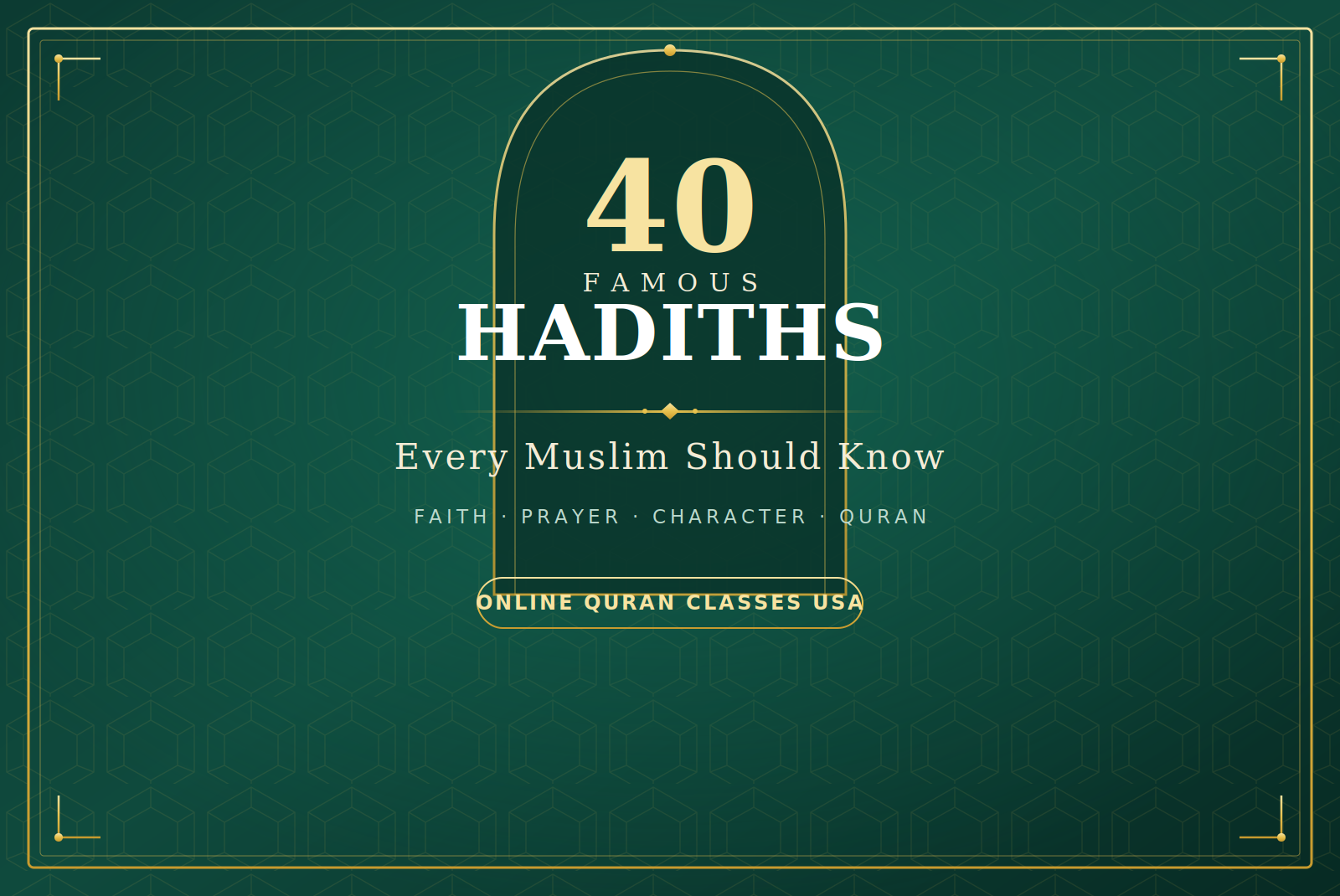
In this article, we have gathered 40 of the most famous and important hadiths every Muslim should know — covering faith, worship, character, relationships, knowledge, and the heart. These hadiths are not just beautiful words; they are a complete roadmap for living as a Muslim in every aspect of life.
Arabic: إِنَّمَا الأَعْمَالُ بِالنِّيَّاتِ
Translation: “Actions are judged by intentions, and every person will get the reward according to what they intended.”
Source: Sahih al-Bukhari 1, Sahih Muslim 1907
This is one of the most quoted hadiths in all of Islam and is often called the “hadith of intentions.” Imam Shafi’i said this single hadith constitutes one-third of all Islamic knowledge. It reminds us that the value of any deed — prayer, charity, fasting — depends entirely on the sincerity of the heart behind it. A person who gives sadaqah to be seen by others receives nothing from Allah. A person who smiles at their neighbour with the genuine intention of pleasing Allah earns reward.
Translation: “Islam is built upon five [pillars]: testifying that there is no god but Allah and that Muhammad is the Messenger of Allah, establishing the prayer, paying the Zakat, making the pilgrimage to the House, and fasting in Ramadan.”
Source: Sahih al-Bukhari 8, Sahih Muslim 16
This foundational hadith outlines the entire structural framework of the Islamic faith. These five pillars — Shahada, Salah, Zakat, Hajj, and Sawm — are the non-negotiable obligations of every Muslim and the subject of entire fields of Islamic jurisprudence.
Translation: “[Ihsan is] that you worship Allah as if you see Him, and if you do not see Him, then [know that] He sees you.”
Source: Sahih al-Bukhari 50, Sahih Muslim 8 (Hadith of Jibril)
This comes from the famous Hadith of Jibril, in which the Angel Jibril (AS) appeared in human form to ask the Prophet ﷺ about Islam, Iman, and Ihsan. The concept of Ihsan — excellence in worship — is the highest level of faith. It means worshipping Allah with full presence, consciousness, and awareness, not merely going through the motions.
Translation: “Truly, in the body there is a morsel of flesh which, if it is sound, the whole body is sound, and if it is corrupt, the whole body is corrupt. Truly, it is the heart.”
Source: Sahih al-Bukhari 52, Sahih Muslim 1599
This hadith is a cornerstone of Islamic spirituality. The Prophet ﷺ teaches us that our entire moral and spiritual state flows from the condition of the heart. This is why Islamic scholars placed such enormous emphasis on tazkiyat al-nafs (purification of the soul) — because a clean heart leads to righteous actions.
Translation: “Faith has over seventy branches — or over sixty branches — the uppermost of which is the declaration: ‘None has the right to be worshipped but Allah’; and the least of which is the removal of harmful things from the road; and modesty is a branch of faith.”
Source: Sahih al-Bukhari 9, Sahih Muslim 35
This hadith beautifully shows that Iman is not just a verbal declaration — it is a living, breathing, active force that expresses itself in countless large and small acts, from the major pillars of worship all the way down to removing an obstacle from a footpath.
Translation: “The first thing the servant will be accountable for on the Day of Resurrection will be his prayer. If it is good, then the rest of his deeds will be good. And if it is bad, then the rest of his deeds will be bad.”
Source: Al-Tabarani, graded Sahih by Al-Albani
Prayer is not just a ritual — it is the foundation on which the entire life of a Muslim is built. This hadith makes clear that the prayer is the benchmark by which all other actions will be measured on the Day of Judgement.
Translation: “The head of the matter is Islam, its pillar is the prayer, and the peak of its hump is jihad in the way of Allah.”
Source: Jami at-Tirmidhi 2616, graded Sahih
This metaphor — using the image of a camel — beautifully illustrates the structure of religious life. Without prayer as the central pillar, the entire structure collapses.
Translation: “The prayer has been made the coolness of my eyes.”
Source: Sunan an-Nasa’i 3940, graded Sahih
Where others might find their greatest joy and comfort in wealth, status, or family, the Prophet ﷺ described Salah as the thing that brought peace and joy to his eyes. This teaches Muslims that prayer should never feel like a burden — it is a refuge, a moment of direct communication with Allah.
Translation: “I asked the Prophet ﷺ: ‘Which deed is most beloved to Allah?’ He said: ‘Prayer offered on time.’ I said: ‘Then what?’ He said: ‘Being good to one’s parents.’ I said: ‘Then what?’ He said: ‘Jihad in the way of Allah.'”
Source: Sahih al-Bukhari 527, Sahih Muslim 85
Among all the righteous deeds a Muslim can perform, the Prophet ﷺ ranked prayer offered in its correct time at the very top. This is a sobering reminder for those who habitually delay or miss prayers.
Translation: “Seeking knowledge is an obligation upon every Muslim.”
Source: Sunan Ibn Majah 224, graded Sahih by Al-Albani
This single hadith dismantles any notion that religious knowledge is only for scholars or clergy. Every Muslim — man, woman, young, and old — is personally obligated to seek the knowledge necessary to worship Allah correctly and live an Islamic life.
Translation: “The best of you are those who learn the Quran and teach it.”
Source: Sahih al-Bukhari 5027
This is perhaps the most motivating hadith for anyone engaged in Quranic education. The Prophet ﷺ did not say the best people are the wealthiest, the most powerful, or the most eloquent — he said the best are those who learn the Quran and pass it on to others.
Translation: “When a person dies, his deeds come to an end except for three: ongoing charity (Sadaqah Jariyah), knowledge from which people benefit, and a righteous child who prays for him.”
Source: Sahih Muslim 1631
This hadith is why Islamic scholars wrote books, why teachers devoted their lives to teaching, and why parents invest in their children’s religious education. Knowledge shared in this world continues to earn reward in the Hereafter.
Translation: “Whoever follows a path in pursuit of knowledge, Allah will make a path to Paradise easy for him.”
Source: Sahih Muslim 2699
Every step taken on the way to a Quran class, an Islamic lecture, or a lesson in Arabic is — according to this hadith — a step on the road to Jannah. This is a profound motivation for students at every level.
Translation: “I was only sent to perfect good character.”
Source: Al-Muwatta of Imam Malik, graded Sahih by Al-Albani
This hadith reveals the moral heart of the Prophet’s entire mission. Islam is not simply a set of rituals — it is fundamentally a religion of character. A Muslim who prays and fasts but deals dishonestly, speaks cruelly, or treats others unjustly has missed the point.
Translation: “Nothing is heavier on the scale of the believer on the Day of Resurrection than good character.”
Source: Jami at-Tirmidhi 2002, graded Sahih
On the Day of Judgement, when deeds are weighed, good character will be among the heaviest on the scale. This tells us that how we treat other people — our patience, our honesty, our kindness — carries enormous weight before Allah.
Translation: “The best of people are those who are most beneficial to people.”
Source: Al-Mu’jam al-Awsat of Al-Tabarani, graded Hasan by Al-Albani
Islam is not a religion of withdrawal from society. The best Muslim is the one who contributes most to the wellbeing of those around them — family, neighbours, community, and humanity at large.
Translation: “Your smiling in the face of your brother is charity (Sadaqah).”
Source: Jami at-Tirmidhi 1956, graded Sahih
This hadith makes clear that charity is not only financial. Every act of genuine kindness — including something as simple as a warm smile — is a form of Sadaqah that earns reward with Allah.
Translation: “Do not consider any good deed as insignificant, even meeting your brother with a cheerful face.”
Source: Sahih Muslim 2626
Small acts of goodness are never wasted in Islam. This hadith encourages Muslims to be consistent in small kindnesses rather than waiting for grand opportunities to do good.
Translation: “The strong person is not one who wrestles others down. The strong person is one who controls himself when he is angry.”
Source: Sahih al-Bukhari 6114, Sahih Muslim 2609
In a world that often equates strength with dominance and aggression, the Prophet ﷺ redefines strength as self-mastery — particularly the ability to manage anger. This is one of the most psychologically insightful hadiths in the entire Sunnah.
Translation: “Truthfulness leads to righteousness and righteousness leads to Paradise. A man keeps speaking the truth until he is recorded with Allah as a truthful person. Falsehood leads to wickedness and wickedness leads to the Hellfire. A man keeps telling lies until he is recorded with Allah as a liar.”
Source: Sahih al-Bukhari 6094, Sahih Muslim 2607
Honesty is not merely a social virtue in Islam — it is a spiritual one with eternal consequences. This hadith traces a clear chain: truth → righteousness → Jannah; lies → wickedness → Hellfire.
Translation: “The rights of one Muslim over another are five: returning the greeting of salaam, visiting the sick, following the funeral procession, accepting an invitation, and responding to the one who sneezes.”
Source: Sahih al-Bukhari 1240, Sahih Muslim 2162
This hadith outlines a social framework that, if practised, creates an incredibly tight-knit and caring community. Every one of these five actions reinforces bonds between Muslims and ensures no one is neglected or isolated.
Translation: “A believer is a mirror to his fellow believer, and a believer is a brother to his fellow believer. He safeguards his property for him and defends him from behind.”
Source: Abu Dawud 4918, graded Hasan
A true friend in Islam is one who shows you your faults with honesty and kindness — not one who flatters you. This metaphor of a mirror teaches Muslims to be genuine, protective, and loyal to one another.
Translation: “None of you truly believes until he loves for his brother what he loves for himself.”
Source: Sahih al-Bukhari 13, Sahih Muslim 45
This concise hadith encapsulates one of the most profound ethical principles in all of religion. It demands that we move beyond self-interest and extend genuine goodwill to others — including competing with them for wealth, status, or opportunities.
Translation: “Jibril kept advising me to be good to my neighbours until I thought he would make them my heirs.”
Source: Sahih al-Bukhari 6014, Sahih Muslim 2624
The rights of neighbours are so heavily emphasised in Islam that the Prophet ﷺ describes Jibril (AS) returning again and again to stress them. Good neighbourliness — checking on them, not harming them, sharing food, keeping their secrets — is a major obligation in Islam.
Translation: “Beware of suspicion, for suspicion is the worst of false tales. Do not spy on one another, do not backbite one another. Be servants of Allah, brothers and sisters.”
Source: Sahih al-Bukhari 6064, Sahih Muslim 2563
This hadith addresses three of the most destructive forces in any community: unwarranted suspicion, spying, and backbiting. All three are prohibited in Islam and all three, if left unchecked, destroy the fabric of brotherhood and sisterhood.
Translation: “The best dhikr (remembrance) is ‘La ilaha illallah’ (There is no god but Allah), and the best supplication is ‘Alhamdulillah’ (All praise is due to Allah).”
Source: Jami at-Tirmidhi 3383, graded Hasan
Dhikr — the remembrance of Allah through the tongue and the heart — is one of the most accessible and powerful acts of worship. This hadith points to two phrases that require nothing but the movement of the tongue and the sincerity of the heart, yet carry immense reward.
Translation: “Two words are light on the tongue but heavy on the Scale and beloved to the Most Merciful: SubhanAllahi wa bihamdihi, SubhanAllahil Adheem.”
Source: Sahih al-Bukhari 6682, Sahih Muslim 2694
“Glory be to Allah and His is the praise; Glory be to Allah, the Magnificent.” — These two short phrases are among the most beloved words to Allah. The hadith reveals a profound theological truth: the weight of a deed before Allah is not determined by how much effort it takes from us.
Translation: “The most beloved of deeds to Allah are those that are most consistent, even if they are small.”
Source: Sahih al-Bukhari 6464, Sahih Muslim 783
This hadith is a direct challenge to the “all or nothing” mentality that many Muslims fall into. Praying two rakaat of Tahajjud every night is more beloved to Allah than praying twenty rakaat once and then abandoning it. Consistency — even in small acts — is the key.
Translation: “Every good deed of the son of Adam will be multiplied — a good deed receiving a tenfold to seven-hundredfold reward. Allah said: ‘Except for fasting, for it is for Me and I shall reward it. He gives up his desire and his food for My sake.'”
Source: Sahih al-Bukhari 1904, Sahih Muslim 1151
Fasting holds a uniquely special status among acts of worship. While other deeds are multiplied by known factors, fasting is described as belonging entirely to Allah — meaning its reward is without limit.
Translation: “The best prayer after the obligatory prayers is the night prayer.”
Source: Sahih Muslim 1163
Tahajjud — the voluntary night prayer — holds a station above all other supererogatory acts of worship. The night, when the world is asleep and distractions are gone, is described in the Quran and Sunnah as the most powerful time for connection with Allah.
Translation: “Recite the Quran, for it will come as an intercessor for its companions on the Day of Resurrection.”
Source: Sahih Muslim 804
One of the most motivating hadiths for Quran learners. The Quran is not merely a book to be recited and set aside — it will appear as an advocate and intercessor for those who honoured it in this life.
Translation: “Whoever recites a letter of the Book of Allah will be credited with a good deed, and a good deed is multiplied tenfold. I do not say that Alif-Lam-Mim is a letter, but rather Alif is a letter, Lam is a letter, and Mim is a letter.”
Source: Jami at-Tirmidhi 2910, graded Sahih
This hadith quantifies in an extraordinary way the reward of Quran recitation. Every single letter — not word, but letter — earns a minimum of ten good deeds. A few pages of Quran recitation can earn hundreds of thousands of good deeds.
Translation: “The one who is proficient with the Quran will be with the noble and righteous scribes (the angels), and the one who recites the Quran and finds it difficult, stammering through it, will have a double reward.”
Source: Sahih al-Bukhari 4937, Sahih Muslim 798
This is one of the most reassuring hadiths for new learners. The beginner who struggles with Arabic pronunciation and Tajweed — who pushes through the difficulty — receives double the reward. Nobody is left behind.
Translation: “There is no envy except in two cases: a man whom Allah has given the Quran and who recites it during the night and during the day, and a man whom Allah has given wealth and who spends it during the night and during the day.”
Source: Sahih al-Bukhari 7529, Sahih Muslim 815
The Prophet ﷺ permitted a special form of envy — not the destructive kind, but the inspirational kind — toward two types of people. The Quran reciter is placed before even the generous donor of wealth.
Translation: “What is the example of this worldly life compared to the Hereafter other than one of you dipping his finger in the sea? Let him see what it returns with.”
Source: Sahih Muslim 2858
Imagine dipping your fingertip into the ocean and lifting it out. The tiny drop that clings to your finger compared to the vast ocean — that is the entire duration of this worldly life compared to the eternal life of the Hereafter. This perspective fundamentally reorders priorities.
Translation: “This world is a prison for the believer and a paradise for the disbeliever.”
Source: Sahih Muslim 2956
The believer in this life is constrained — bound by halal and haram, by obligations and prohibitions, by tests and trials. But these constraints are temporary, and what lies beyond them is infinite. The one who lives without these constraints may enjoy worldly freedom, but has forfeited the eternal.
Translation: “Be in this world as if you were a stranger or a traveller passing through.”
Source: Sahih al-Bukhari 6416
Ibn Umar (RA), who narrated this hadith, would say: “When you reach the evening, do not wait for the morning. When you reach the morning, do not wait for the evening. Take from your health for your illness, and from your life for your death.” The world is not our home — it is a journey, and the believer should travel light.
Translation: “When Allah created the creation, He wrote in His Book which is with Him above the Throne: ‘My mercy prevails over My wrath.'”
Source: Sahih al-Bukhari 3194, Sahih Muslim 2751
No matter what a person has done, no matter how far they have drifted, this hadith stands as one of the most powerful assurances in Islam. The mercy of Allah is not equal to His wrath — it surpasses it. This is the door of hope that is never fully closed to the sincere servant.
Translation: “Allah is more delighted with the repentance of His servant than one of you would be if you lost your camel in the desert and then found it.”
Source: Sahih al-Bukhari 6309, Sahih Muslim 2747
Imagine losing your camel in the desert — your sole means of transport, survival, and livelihood. Imagine the relief and joy of finding it again. Allah’s delight at the sincere repentance of His servant surpasses even that. Tawbah (repentance) is one of the most beloved acts to Allah.
Translation: “Allah stretches out His hand at night to accept the repentance of the one who sinned during the day, and He stretches out His hand during the day to accept the repentance of the one who sinned during the night — until the sun rises from the West.”
Source: Sahih Muslim 2759
This hadith closes our collection with a message of immense hope. As long as a person is alive and the sun has not risen from the West (one of the major signs of the Day of Judgement), the door of repentance is open. It is never too late to turn back to Allah.
Understanding hadith is not just an academic exercise — it is essential for living an authentic Islamic life. Without the Sunnah, Muslims would not know how to pray, how to perform Wudu, how to calculate Zakat, or how to perform Hajj, because these details are not fully specified in the Quran alone. The Prophet ﷺ himself was the living interpreter of the Quran.
Imam Al-Awza’i, one of the great early scholars of Islam, said: “The Quran has more need of the Sunnah than the Sunnah has of the Quran.” By this he meant that the Sunnah explains, contextualises, and operationalises the Quran in practical life.
Learning hadiths is one thing — living them is another. Here are some practical ways to make these 40 hadiths a part of your daily life:
Memorise one hadith per week. Starting with short ones like #17 (smiling is charity) or #27 (SubhanAllah phrases), build a personal collection of hadiths you know by heart.
Reflect before acting. Before beginning any task — whether work, cooking, or spending time with family — pause and recall hadith #1. Ask yourself: what is my intention here? Am I doing this to please Allah?
Apply the akhlaq hadiths at home. Hadiths #19 (controlling anger), #20 (honesty), and #24 (rights of neighbours) can be practised every single day without any additional resources.
Use the Quran hadiths (#31–34) as motivation. If you struggle with Quran recitation, remember hadith #33 — your double reward — every time the Arabic letters feel difficult.
Return to hadith #38–40 when you feel you have sinned or drifted. These three hadiths on mercy and repentance are a spiritual lifeline for every Muslim who is struggling.
The Prophet ﷺ said: “The best of you are those who learn the Quran and teach it.” (Sahih al-Bukhari 5027)
Learning the Quran and the Sunnah together is the foundation of a strong Islamic life. At Online Quran Classes USA, we offer structured, 1-on-1 online Quran and Islamic education for kids, adults, and ladies — from beginners learning to read Arabic for the first time to advanced students pursuing Tajweed and Ijazah.
Our certified teachers are available 24/7 and teach in English, Urdu, Arabic, and more. Whether you want to learn to read the Quran, memorise it, or understand it through Tafseer, we have a course designed for you.
👉 Book your 3 free trial classes today — no commitment required.
The Sunnah refers to the Prophet’s ﷺ way of life — his practices, habits, and rulings. The Hadith are the recorded narrations that document the Sunnah. All authentic hadiths are part of the Sunnah, but not all aspects of the Sunnah are necessarily recorded in hadith form.
Sahih (صحيح) means “authentic” or “sound.” It is the highest grade of hadith authenticity, meaning the chain of narrators is unbroken and all narrators are reliable. Sahih al-Bukhari and Sahih Muslim are the two most trusted hadith collections.
Hasan (good/acceptable) hadiths are acted upon by scholars in all areas of Islamic law. Weak (Da’if) hadiths are generally not used as the basis for legal rulings but may be used, with caution, in matters of virtuous deeds (fadail al-a’mal) according to some scholars.
Hundreds of thousands of hadiths were collected and recorded by early scholars. After rigorous authentication, Imam al-Bukhari — who reportedly examined over 600,000 hadiths — selected approximately 7,275 unique hadiths for his Sahih. Sahih Muslim contains around 7,500 unique hadiths.
Yes. Following the Prophet ﷺ is a Quranic commandment (Surah Al-Imran 3:31, Surah Al-Ahzab 33:21, Surah Al-Hashr 59:7). Denying the authority of the Sunnah as a source of Islamic law is considered a deviation from orthodox Islamic belief.
Learn the Quran with the guidance of the Sunnah. Explore our Islamic Courses and Quran Courses at Online Quran Classes USA.
